

Post-Reels is AffNova’s series about slots that are starting to behave like something else — games that push beyond traditional reels through unconventional mechanics, progression systems and ideas borrowed from video games.
In our Concrete Cowboys review, the grid became a playfield. Chomplings turned it into an ecosystem. Eldritch Dungeon borrowed the structure of an RPG run, while Star Guardians gave the player direct control of a third-person shooter.
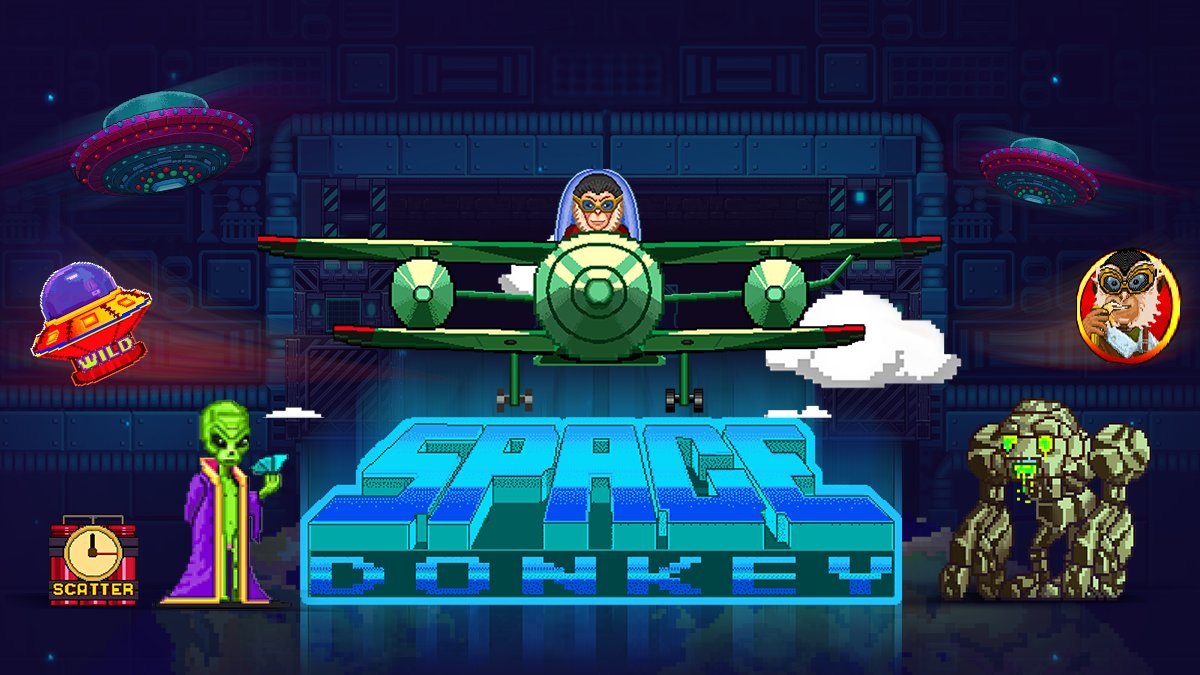
Space Donkey by Nolimit City takes us back to the golden age of arcade gaming.
Behind its absurd title, pixelated aliens and heavily armed Monkey lies a surprisingly ambitious experiment: two distinct bonus modes that transform a conventional slot into a maze adventure and a retro alien shooter.
There are traps, treasure chests, weapons, lives, enemies, rocket launchers and even a Mothership waiting to be destroyed.
But there's one crucial difference from a real arcade game.
You don't control the Monkey.
And that makes Space Donkey a particularly interesting candidate for the question behind Post-Reels:
Is this still a slot?

Space Donkey: Quick Facts
Feature | Details |
Provider | Nolimit City |
Release | October 3, 2023 |
Grid | 6×6 |
Win Ways | 46,656 |
Default RTP | 96.07% |
Volatility | 8/10 (High) |
Hit Frequency | 27.68% |
Free Spins Frequency | 1 in 298 |
Max Win | 14,649× bet |
Main Features | Abduction Wild, Hellfire |
Bonus Modes | Hide N' Seek, Seek N' Destroy |
The figures come from Nolimit City's official Space Donkey game page and product sheet. The developer also offers lower-RTP configurations, so the figures can vary depending on the version.
A Slot Straight Out of an Arcade Cabinet
At first, Space Donkey remains recognisably a slot.
The base game uses six reels and six rows, with 46,656 ways to win. Its two principal mechanics, Abduction Wild and Hellfire, give the main game some of Nolimit City's familiar multiplier-driven complexity.
Abduction Wilds descend through the reels, collecting paying symbols and increasing their multipliers. Hellfire introduces Chopper symbols that fire in different directions, adding multipliers to the symbols in their paths.
So far, this is still conventional slot territory.
But the game's personality is already unusual.
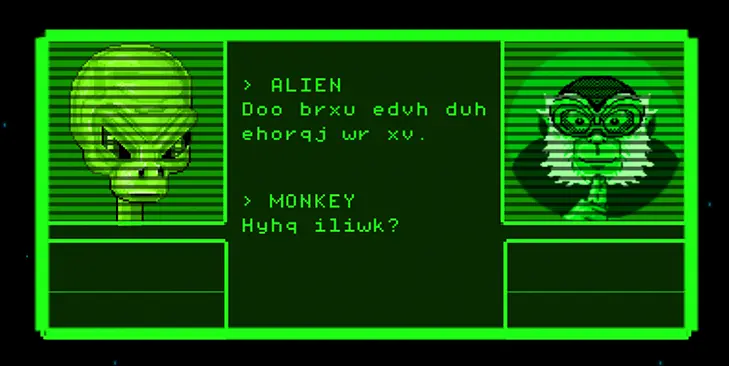
Its pixel-art characters, retro science-fiction environments, chiptune-inspired audio and absurd alien-invasion storyline feel borrowed from the era of arcade cabinets and early home consoles.
Nolimit City explicitly acknowledged this inspiration in its official launch announcement, describing Space Donkey as a tribute to the golden age of arcade gaming.
And it's when the bonus features begin that the tribute becomes something considerably more interesting.
What Makes Space Donkey Post-Reel?
Space Donkey doesn't simply replace the reels with a different grid.
It introduces two almost entirely different gameplay systems, each borrowing rules from classic video games.
Hide N' Seek resembles a turn-based maze or board game, where a character moves around a hazardous environment collecting rewards.
Seek N' Destroy becomes an automated arcade shooter, complete with different weapons, advancing enemies, defensive resources and a final boss.
And the two modes can connect.
Events in Hide N' Seek can trigger Seek N' Destroy, while surviving lives can become additional shields in the following battle.
This is more than putting a few arcade animations between free spins.
The bonus features have their own movement rules, objectives, hazards and progression systems.
The slot stops looking like consecutive spins and starts looking like a sequence of arcade levels.
Hide N' Seek: The Monkey Enters the Maze
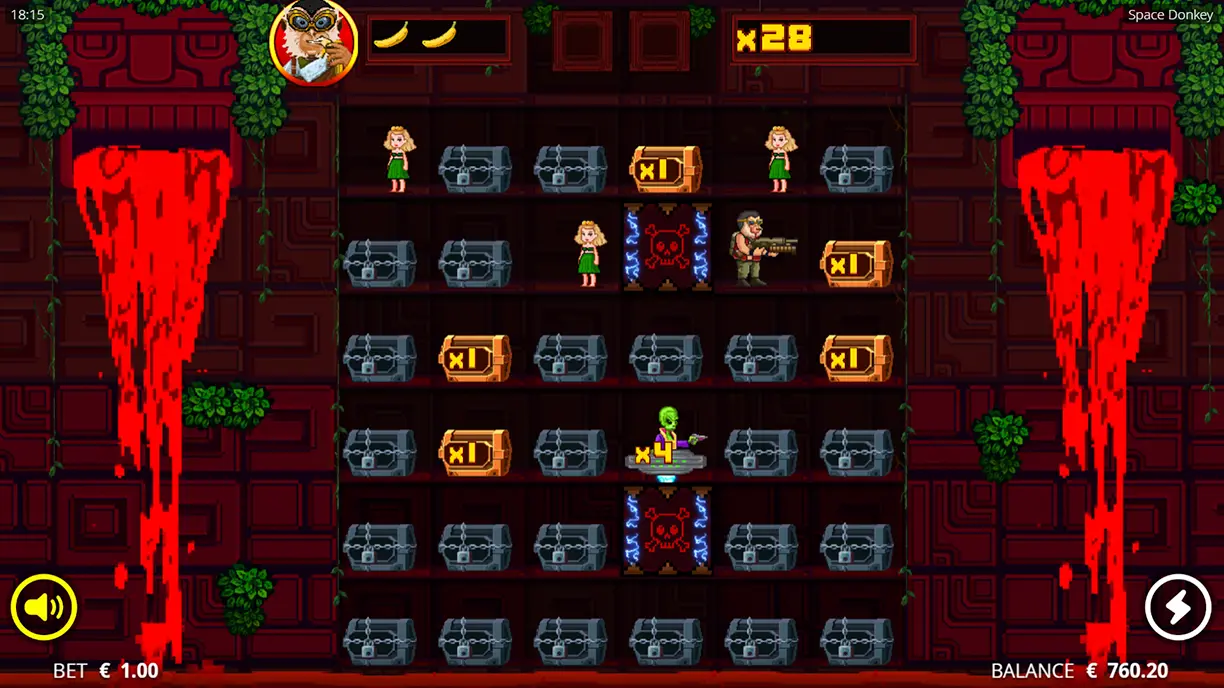
Landing three Scatters triggers Hide N' Seek, replacing the regular reels with a 6×6 maze.
The Monkey begins with three lives.
Each turn determines a direction and number of steps, sending the character across a board populated with treasure chests, aliens, traps and unusual supporting characters.
The board's opposing edges are connected, so movement can wrap around the playfield.
And every encounter matters.
Golden Chests provide multiplier values. Grey Chests can contain additional lives, multipliers, upgrades or surprises. Traps and hostile aliens threaten the Monkey's survival.
But several characters introduce more complicated interactions.
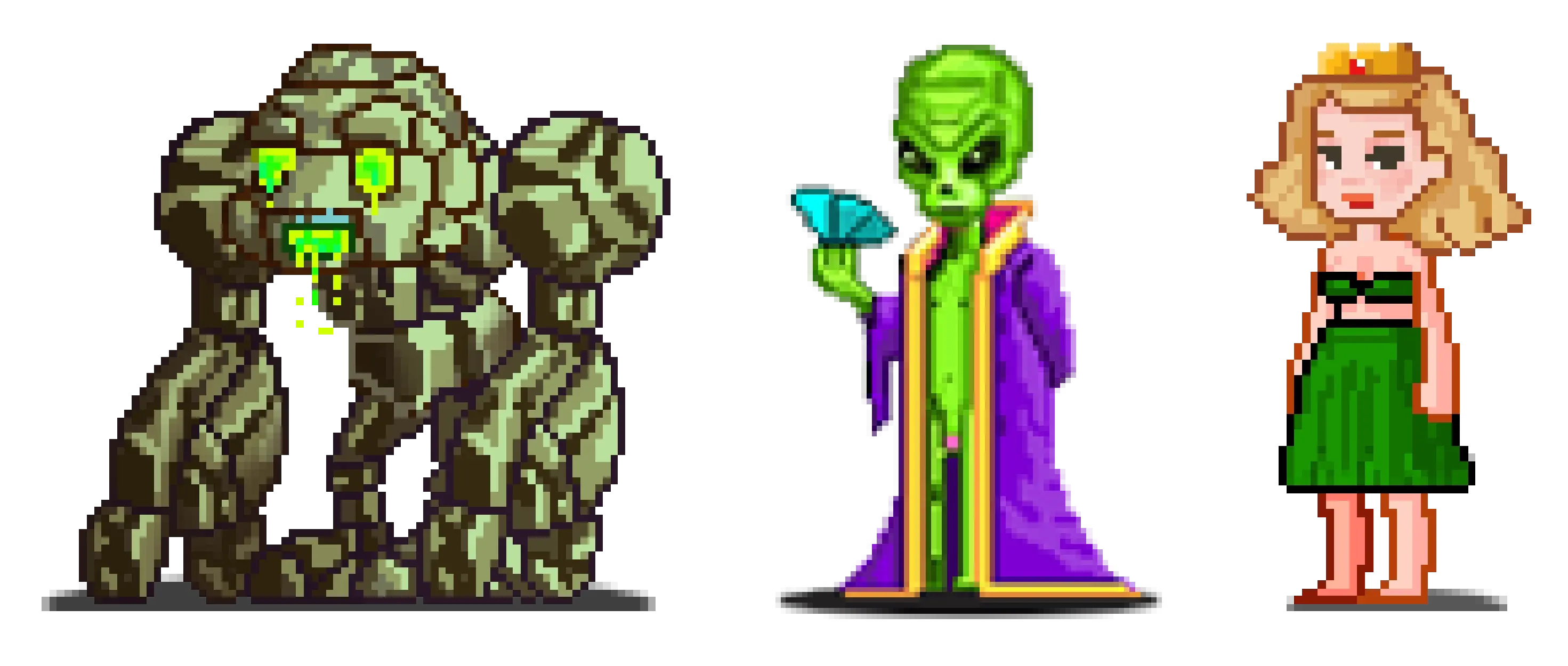
The King multiplies the values of Golden Chests.
The Magician awards the combined value of visible Golden Chests.
The Princess collects values from adjacent chests and eliminates nearby aliens.
The Stone Monster can affect multiple objects, upgrading chests or destroying enemies.
And a discovered Teleport immediately sends the game into Seek N' Destroy.
These mechanics create the feeling of a small turn-based adventure.
A chest might suddenly become more valuable. An enemy might alter another object's value. A single movement could trigger several connected effects.
But the player isn't choosing a path.
The Monkey explores the maze automatically, and we watch the consequences.
That is the central contradiction of the feature: it borrows the logic of a board game while removing the decisions normally made by its player.
Seek N' Destroy: When the Bonus Becomes Space Invaders
Landing four Scatters can trigger Seek N' Destroy directly.
And this is where Space Donkey becomes genuinely remarkable.
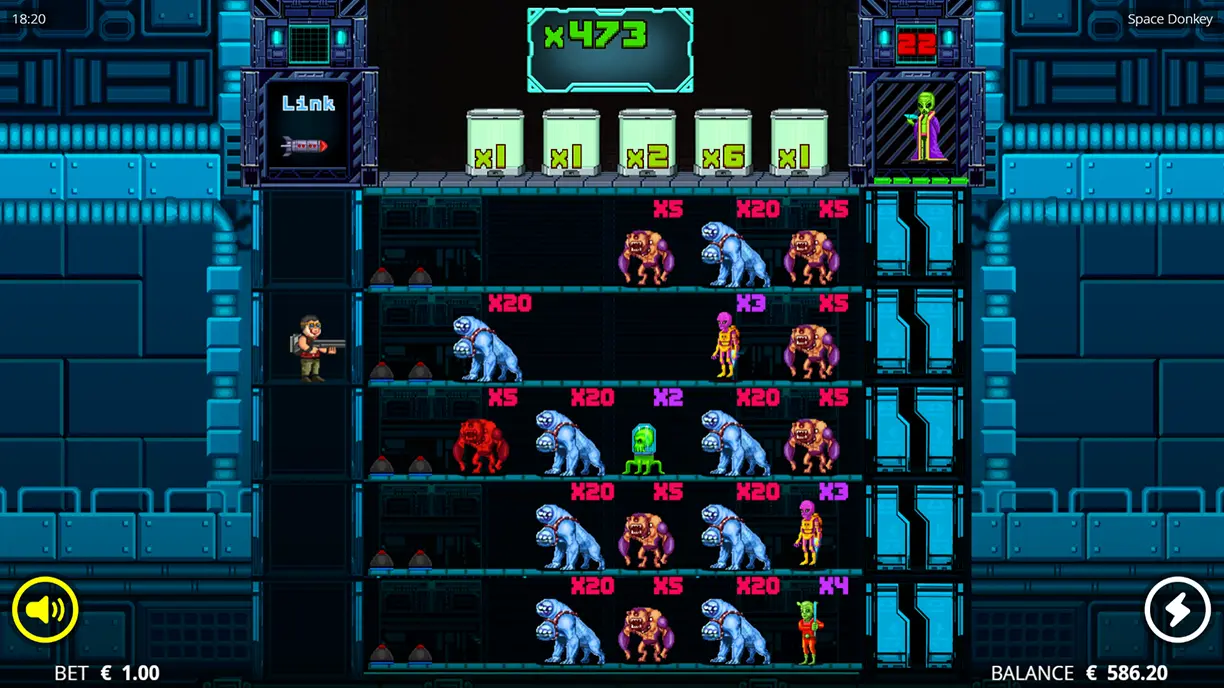
The bonus transforms into a 5×6 battlefield inspired by classic alien shooters, particularly the structure of Space Invaders.
The Monkey occupies the left side of the screen while aliens advance from launcher tubes on the opposite side.
Every turn follows a sequence.
The Monkey moves to a randomly selected row.
Aliens advance.
Launcher tubes generate new enemies.
A weapon is randomly selected and fired.
Destroyed aliens contribute values multiplied by the corresponding column multipliers.
It sounds straightforward, but the different weapons create surprisingly varied outcomes.
The Link Gun attacks aliens of the same type.
The Laser Gun fires across a row.
The Nuke attacks enemies in a column.
The Rail Gun eliminates an individual alien.
Upgrades can increase their effectiveness, while shields allow the Monkey to survive longer against advancing enemies.
Here, the game starts behaving less like a conventional bonus and more like an automated arcade battle.
The Monkey must survive.
The aliens keep advancing.
Weapons have different tactical effects.
And behind the enemy waves sits the larger objective.
Destroy the launcher tubes. Defeat the Mothership.
Monkeypendence Day: The Arcade Endgame
One of Seek N' Destroy's most interesting mechanics involves the launcher tubes from which aliens continuously emerge.
These structures aren't merely decorative.
They have their own health values, and weapons can damage them. Destroying a launcher tube awards 100× bet, eliminates nearby aliens and permanently stops that tube from generating further enemies.
The Mothership itself has 25 lives, which decrease as launcher tubes are hit.
Destroy all the tubes or defeat the Mothership, and the feature reaches Monkeypendence Day.
A final multiplier of 5×, 10×, 15× or 20× is applied to the accumulated bonus win.
That gives the whole sequence something resembling a classic arcade endgame.
There is a battlefield.
There are enemies.
There are structures generating those enemies.
And there is a final objective whose destruction ends the battle.
The most spectacular outcomes are exceptional. In this recorded Space Donkey max-win example, the Monkey destroys the alien-spawning structures before the bonus culminates in the game's 14,649× maximum payout.
Such results are extremely rare — Nolimit City lists the maximum-win probability as approximately 1 in 10 million spins for the 96.07% RTP version.
But what matters mechanically is how the game gets there.
The battlefield changes as the structures disappear, bringing the Monkey closer to a recognisable final victory.
It is an arcade boss fight translated into slot mathematics.
Does the Arcade Experiment Actually Work?
Surprisingly well.
Space Donkey succeeds in an area where many mechanically ambitious slots struggle: its visual presentation and gameplay concepts feel like parts of the same experience.
The pixel art is excellent.
The animations capture the exaggerated movement and visual effects of retro arcade games.
The sound design supports that atmosphere, making weapons, encounters and victories feel satisfying without abandoning the deliberately old-fashioned aesthetic.
And most importantly, the combat generates real tension.
Watching aliens advance while the Monkey switches positions, fires different weapons and tries to survive can be genuinely exciting.
The same applies to Hide N' Seek, where each new movement can change the state of the maze.
The results don't feel like ordinary free spins decorated with arcade graphics.
They feel like miniature games unfolding in front of you.
There is, however, an important limitation.
You are not playing those games yourself.
You aren't selecting weapons, choosing movement directions or deciding which enemies to target.
The entire experience remains automated.
And yet, unlike many game-like bonus features, Space Donkey manages to make watching that automation entertaining.
The lack of control doesn't eliminate the excitement.
The Star Guardians Paradox
This creates an interesting contrast with our Star Guardians review.
Evoplay's experimental shooter offered direct control over movement, aiming and shooting.
Conceptually, that made it one of the most radical Post-Reels titles we had encountered.
But its awkward controls and uneven execution weakened the experience.
Space Donkey approaches the same problem from the opposite direction.
The Monkey fights aliens.
Weapons behave differently.
Enemies advance.
The battlefield changes.
But the player controls none of it.
And somehow, the automated arcade experience can feel more entertaining than the shooter that actually hands you the controls.
That raises an important question.
Does borrowing video-game mechanics necessarily require giving the player agency?
Or can a slot recreate the tension of another genre simply by reproducing its internal rules convincingly?
Space Donkey suggests the second possibility deserves more attention.

What Is Space Donkey Becoming?
An arcade shooter?
A board game?
A retro adventure?
In a way, all three.
And that is precisely what distinguishes it from many other experimental slots.
Instead of building one complicated new system, Nolimit City combines two recognisable arcade structures inside a traditional gambling framework.
Hide N' Seek borrows movement, encounters and environmental hazards from turn-based games.
Seek N' Destroy borrows enemy waves, weapon types, defensive resources and boss battles from arcade shooters.
The two modes even communicate with one another through transitions and additional shields.
This creates a kind of miniature arcade anthology inside a slot.
The player begins with conventional reels, enters a maze, and may eventually find themselves watching an alien invasion unfold.
The interesting development isn't simply that the bonus contains more mechanics.
The bonus becomes a game with its own rules, objectives and ending.
Is Space Donkey Still a Slot?
Technically?
Absolutely.
The main game remains a conventional 6×6 video slot.
The player chooses a stake, spins the reels and can trigger or purchase bonus features where permitted.
And despite their arcade-like appearance, both bonus modes unfold according to the game's underlying gambling mathematics.
There is no direct tactical control.
No manual shooting.
No choosing the Monkey's route.
But experientially, the answer is more complicated.
During Hide N' Seek, you're watching a character navigate a maze, survive traps and interact with other inhabitants.
During Seek N' Destroy, you're watching a small-scale war unfold against an invading alien force.
And when the launcher tubes begin disappearing, the experience increasingly resembles the climax of an old-school arcade shooter.
Space Donkey doesn't give you the arcade controls.
It gives you the arcade experience as a spectacle.
That may be its most interesting achievement.

Post-Reels Verdict
Mechanical Innovation: 8.5/10
Execution: 9/10
Post-Reel Factor: 9.5/10
Overall: 9/10
Space Donkey is one of the most convincing examples of experimental slot design we've encountered in Post-Reels.
Its two bonus modes don't simply imitate arcade aesthetics. They incorporate movement rules, character interactions, different weapons, enemies, lives, defensive structures and objectives borrowed from classic games.
The quality of the pixel art, animation and sound makes those systems especially enjoyable to watch.
And despite the complete absence of direct player control, the action remains genuinely tense.
That is the central achievement — and the central contradiction — of Space Donkey.
It borrows nearly everything from classic arcade games except the thing that normally defines them:
the player behind the controls.
Yet the experiment still works.
Maybe the future of experimental slots isn't always about giving players more things to do.
Sometimes, it's about making the systems they watch considerably more interesting.
Space Donkey doesn't let you play the arcade game.
It makes the arcade game play itself.

Related reading
Star Guardians Slot Review: Sci-Fi Shooter
Star Guardians is an experimental third-person shooter slot from Evoplay where players manually move, aim and shoot through 3D environments, choose between distinct characters, collect loot and fight alien enemies. Ambitious and highly original, it pushes far beyond traditional slot design — even if its rough controls and uneven execution hold the experience back.
Eldritch Dungeon Slot Review: RPG Meets Slots
Eldritch Dungeon is an experimental 8×8 Cluster Pays slot from Print Studios that blends traditional slot mechanics with dungeon-style progression. Players choose a companion, collect Power Relics, battle monsters, gather keys and enter the Treasure Hall, where coins merge across an expanding grid. It feels less like a standard bonus feature and more like a short dungeon run.