
When players choose to exclude themselves from online gambling, they should be able to understand how long that decision will remain in effect. Yet in our latest research at Casino.net, we found that more than half of the self-exclusion listings in our database did not specify an exclusion period.
We examined 903 self-exclusion listings across 540 casino brands in 64 markets. Only 409 listings recorded a duration. This does not mean the other operators do not offer effective exclusions. It means that the duration was not captured in the information we examined – an important distinction when discussing player protection.
Our study is the first edition of a wider Casino.net Research Lab series examining how responsible gambling tools are documented. We based it on our operator database as it stood on 5 October 2026, comprising 1,064 live operator-market records and 4,228 responsible gambling values, including deposit limits and time-outs.
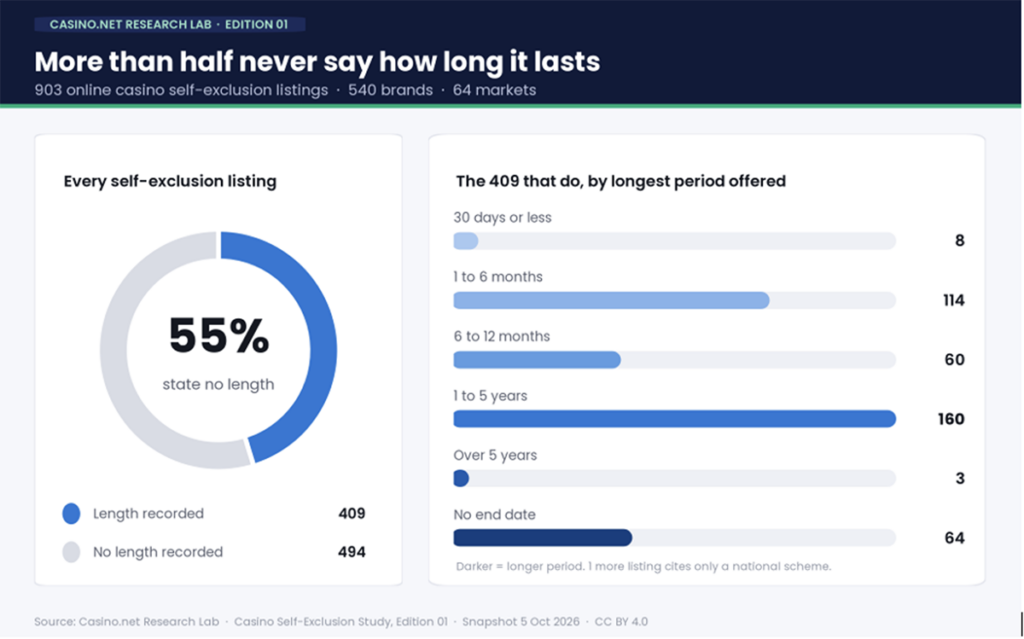
Self-exclusion listings by longest period recorded. Casino.net Research Lab, CC BY 4.0.
What the differences between markets tell us
One of the clearest findings is how much recorded information varies by market. In Great Britain, 117 of 132 self-exclusion listings, or 88.6 per cent, included a period. That was the highest rate among the 31 markets in our study with at least ten listings.
In 78 British listings, the period was described as ranging from six months to five years. The Gambling Commission’s ordinary code 3.5.4 expects licensees to offer self-exclusion for at least six months.
Elsewhere, our database painted a different picture. We found a stated period in just three of 25 listings in Germany (12 per cent), four of 23 in Ireland and seven of 28 in Romania. None was recorded in the listings we examined for Andorra and Nigeria.
It is particularly important not to confuse a gap in recorded information with a gap in legal protections. Germany, for example, has a national OASIS exclusion register, under which exclusions normally last one year by default and cannot be shorter than three months. Our figures describe what appears in our database, not whether an operator is meeting the law.
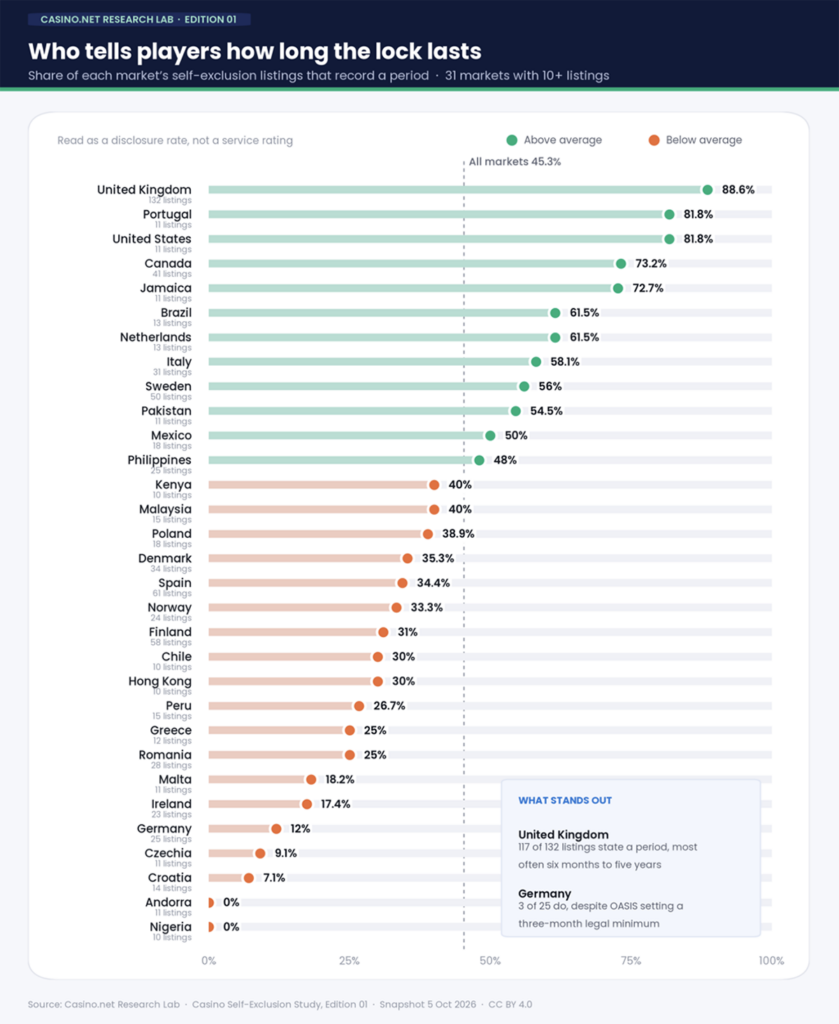
Share of listings recording a self-exclusion period by market. Casino.net Research Lab, CC BY 4.0.
Not every exclusion means the same thing
We also saw considerable variation in the durations themselves. Eight listings recorded periods of 30 days or less, including options such as a 24-hour panic button. At the other end, three listings specified fixed periods exceeding five years, while 64 recorded an exclusion without an end date.
Some of the longest periods in our data included Betclic in Poland, with an option extending up to 21 years; Stake in Norway, up to ten years; and Hippodrome in Great Britain, up to six years. Where an operator listed a range, we counted the longest period it offered.
This underlines why terminology matters. A short break and a multi-year self-exclusion are not identical measures. Simply recording that a tool exists does not tell the full story about the choices presented to players.
What deposit limits reveal about disclosure
We compared the self-exclusion findings with the way deposit limits are recorded in the same database. Of 781 deposit-limit listings, 460 (59 per cent) specified daily, weekly and monthly periods. In Great Britain, 117 of 128 deposit-limit listings (91 per cent) recorded all three. By comparison, approximately 45 per cent of the 903 self-exclusion listings recorded an exclusion period.
This comparison suggests there is room to describe self-exclusion options with greater consistency. The point is not to rank operators by a single number, but to make information easier to understand and compare.
A wider conversation about player protection
The findings come as regulators and policymakers consider ways to connect self-exclusion systems across operators or regions. In Argentina, for example, San Juan has been negotiating an arrangement with Mendoza and San Luis to link provincial exclusion registers.
I hope our research contributes to that wider discussion by showing where recorded information is clear and where it is incomplete. If players are to make informed decisions, the terms of protective tools need to be understandable.
We are also careful about what our data cannot establish. This was an analysis of our recorded operator information, not a direct audit of operator practices. A listing without a stated duration may still be backed by a sound exclusion process, and a longer maximum period does not automatically mean that a casino is safer.
We have made the full dataset available under a CC BY 4.0 licence so that others can examine the findings and build on them.