


Choosing the best casino affiliate program in India isn't simply about finding the highest commission percentage. A 50% revenue share can be far less valuable than a reliable 30% deal if the casino has poor conversion rates, weak player retention, limited payment options, or inaccurate tracking.
For affiliates targeting India, the decision requires particular attention to geographic restrictions, local payment preferences, mobile usability, and the terms under which operators accept Indian traffic. The Indian iGaming market also presents regulatory complexities, making it essential to verify whether a specific operator and its affiliate program can legally serve the intended audience.
So, what should you look for when comparing online casino affiliate programs in India?
In this guide, we'll examine the factors that influence casino affiliate earnings, from CPA deals and revenue share to tracking technology, payment processing, player lifetime value, and GEO eligibility. We'll also explain how to compare affiliate offers and identify the right program for your website, traffic source, and business goals in 2027.
What Is a Casino Affiliate Program?
A casino affiliate program is a partnership between an online gambling operator and a marketer who promotes the operator's services in exchange for commissions on qualifying player activity.
The business model involves three main parties:
The affiliate: A website owner, content creator, media buyer, or publisher who attracts relevant visitors through content, advertising, social media, or other permitted channels.
The casino operator: The company that operates the gambling platform, manages player accounts, processes transactions, and provides the gaming service.
The player: The visitor who follows an affiliate link and may register, deposit funds, or become an active customer.
The affiliate receives a commission according to the partnership agreement. Depending on the program, compensation may be based on qualified depositing players, the revenue generated by referred players, or a combination of both.
Most casino affiliate programs use one of three primary payment models: Revenue Share, Cost Per Acquisition (CPA), or Hybrid.
Before comparing programs, it's important to understand several common terms:
Term | Meaning (table) |
FTD | First-Time Depositor: a player who makes their first qualifying deposit. |
CPA | Cost Per Acquisition: a fixed payment for each player who meets the program's acquisition requirements. |
RevShare | Revenue Share: a percentage of qualifying revenue generated by referred players. |
NGR | Net Gaming Revenue: revenue calculated after specified deductions under the affiliate agreement. |
Hybrid | A commission structure combining CPA and Revenue Share. |
GEO | Geographic location or market targeted by an affiliate campaign. |
How Casino Affiliates Make Money
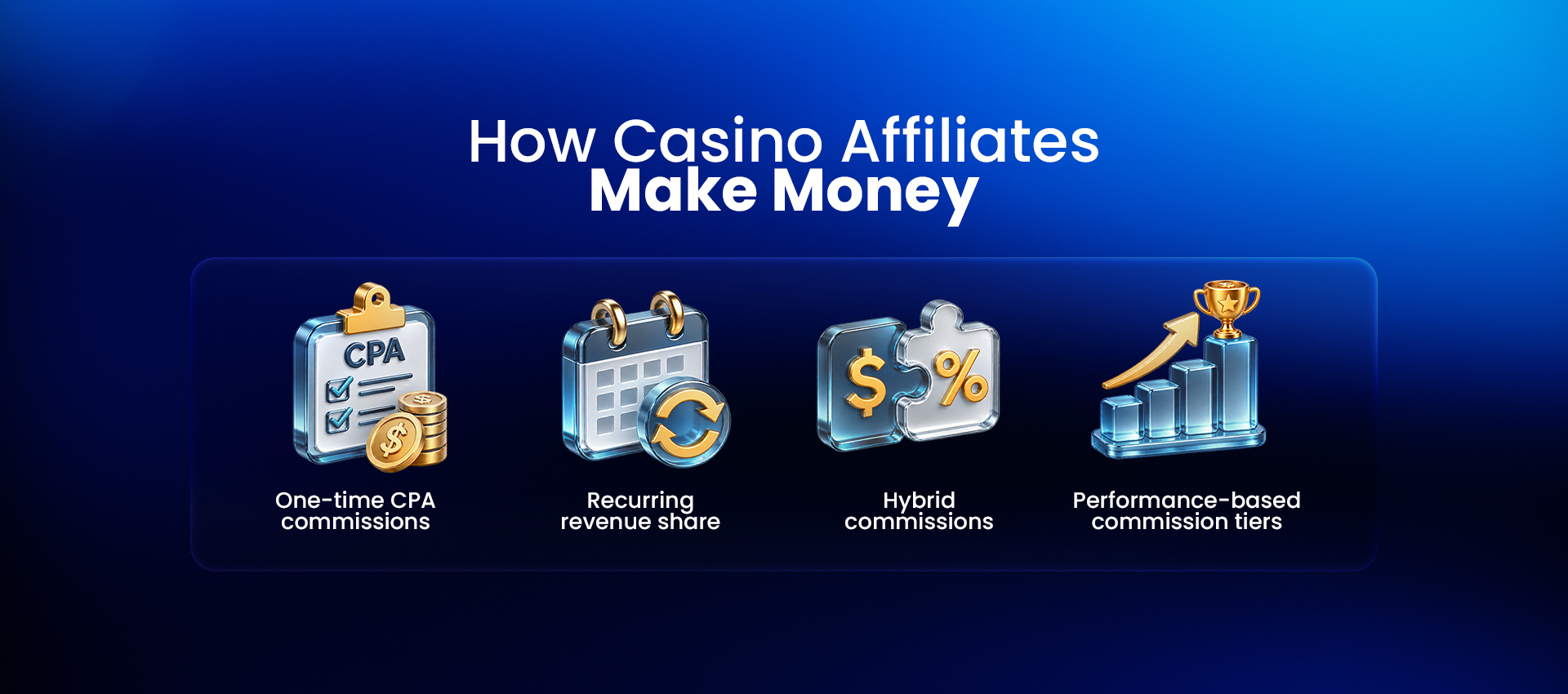
Casino affiliates generally earn through four mechanisms.
1. One-time CPA commissions
Under a CPA deal, the affiliate receives an agreed payment when a referred player satisfies the qualification criteria. These may include registration, identity verification, a minimum deposit, or other requirements specified in the agreement.
2. Recurring revenue share
With Revenue Share, the affiliate earns a percentage of the eligible revenue generated by referred players over time. Earnings may continue while those players remain active and the partnership agreement remains in force.
3. Hybrid commissions
Hybrid deals combine an upfront CPA payment with an ongoing share of qualifying player revenue. They can offer a balance between immediate compensation and potential long-term earnings.
4. Performance-based commission tiers
Some programs offer different rates depending on player volume, traffic quality, or other performance indicators. Affiliates with a proven record may be able to negotiate improved terms.
However, the initial commission is only part of the picture. Player lifetime value (LTV) is often more important when evaluating long-term profitability. A smaller initial payment or revenue-share percentage can be more attractive if the operator converts visitors efficiently and retains players over time.
It's also useful to distinguish between a casino affiliate program and a casino affiliate network. A program is generally operated by an individual brand or operator. A network, by contrast, may provide access to multiple advertisers through a shared platform, with centralized tracking, reporting, and payments. The exact structure depends on the provider.
What Is the Best Casino Affiliate Program for Indian Affiliates?
The best casino affiliate program for Indian affiliates is the one that fits their audience, acquisition channel, business model, and compliance requirements—not necessarily the one advertising the highest commission.
For example, an SEO publisher may value transparent revenue-share terms and accurate lifetime attribution. A media buyer may prioritize predictable CPA economics, fast reporting, and clear rules for paid traffic. A smaller publisher may prefer accessible entry requirements and responsive affiliate support.
The following criteria provide a practical starting point.
1. Competitive CPA and Revenue Share
Compare the actual payment terms rather than the headline percentage. A 40% revenue share does not automatically outperform a 25% offer if the first program applies substantial deductions or has lower player retention.
For CPA deals, establish exactly what constitutes a qualified player, whether minimum deposits apply, and whether additional verification is required.
2. India GEO Support
Confirm that the program explicitly accepts traffic from India. Some international operators restrict particular countries, while others may accept registrations but impose limitations on acquisition sources or promotional methods.
Never assume that an international affiliate offer is available for Indian traffic simply because its website can be accessed from India.
3. Brand Reputation and Player Trust
A recognizable brand with clear terms, responsive customer support, and a reliable player experience may convert better than an unfamiliar operator offering a larger commission.
Review the operator's licensing information, applicable regulatory status, complaints history, and transparency around withdrawals and account verification.
4. Conversion Rates and Player Retention
Registration numbers alone don't tell the whole story. Evaluate how many visitors register, how many complete a first deposit, and how many remain active.
Where reliable data is available, compare registration-to-deposit conversion, FTD rates, average qualifying revenue, retention, and churn.
5. Payment Processing
Payment availability can influence whether an eligible visitor completes registration and a first deposit. For Indian audiences, investigate whether the operator supports appropriate local payment options and whether deposits and withdrawals are available under the same conditions.
The availability of UPI, cards, e-wallets, or bank transfers should be verified with each operator rather than assumed.
6. Reliable Tracking and Reporting
A good casino affiliate dashboard should provide useful information about clicks, registrations, FTDs, commission calculations, and payment status.
Check tracking windows, attribution rules, reporting delays, and how the program handles duplicate accounts or cross-device journeys.
7. Transparent Terms and Timely Payments
Read the agreement for minimum payout thresholds, payment schedules, NGR deductions, negative carryover, and the operator's right to modify commission rates.
A high commission is less attractive if payments are frequently delayed or the calculation method is unclear.
8. Affiliate Support and Marketing Resources
A dedicated casino affiliate manager can help clarify eligibility, discuss commercial terms, and resolve tracking questions. Useful banners, landing pages, localized materials, and conversion reports can also improve campaign efficiency.
In short, a strong program combines competitive commissions, reliable tracking, suitable GEO coverage, a credible operator, transparent terms, and a player experience that supports conversion and retention.
Best Casino Affiliate Programs for India in 2027
When researching the best casino affiliate programs in India, start by identifying operators and networks that explicitly accept your intended traffic. Then compare their commercial terms and operating requirements.
Affiliate conditions can change, and public commission rates do not necessarily reflect the offer available to an individual publisher. The following comparison framework helps you assess programs without relying on unverified rates or outdated promotional claims.
Casino Affiliate Program Comparison
Evaluation factor | What to verify(table) |
Program or operator | Legal entity, operating brand, and official affiliate agreement |
CPA | Current rate and qualified-player requirements |
Revenue Share | Percentage, eligible revenue definition, and deductions |
Hybrid option | Availability and the balance between upfront and recurring commissions |
India traffic acceptance | Written confirmation of India GEO eligibility |
Payment methods | Available methods for affiliate payouts and supported player transactions |
Minimum payout | Minimum commission balance required for payment |
Payment frequency | Weekly, biweekly, monthly, or another documented schedule |
Affiliate support | Account manager, support channels, and response times |
Tracking | Dashboard, attribution window, reporting accuracy, and sub-affiliate support |
Important: The table above is an evaluation framework, not a verified ranking of individual programs. CPA rates, revenue-share percentages, minimum payouts, payment methods, and India eligibility must be confirmed against current program terms before publication or application.
Which Type of Affiliate Program Is Best for Your Business?
Different affiliate businesses need different commercial arrangements.
Affiliate type | What to prioritize |
Beginners | Clear terms, accessible entry requirements, responsive support, and understandable reporting |
SEO affiliates | Long-term attribution, recurring commissions, content-friendly landing pages, and player retention |
High-traffic websites | Scalable commercial terms, performance tiers, reliable tracking, and account management |
PPC and media buyers | Explicit paid-traffic permission, clear brand-bidding rules, measurable conversion data, and predictable economics |
Influencers and content creators | Permitted promotional formats, social media rules, localized assets, and transparent attribution |
Publishers with high-value traffic | Retention, player value, NGR transparency, and negotiable commercial terms |
For publishers focused on Indian traffic, the first question should always be whether the operator can lawfully serve the intended audience and whether its affiliate agreement permits the planned promotional activity.
Once eligibility is established, compare offers based on expected net earnings rather than headline commission rates.
How Casino Affiliate Commissions Work

Casino affiliate commissions determine how much an affiliate earns from the players they refer. Understanding the calculation method is essential because two programs offering similar rates can produce very different results.
CPA vs Revenue Share vs Hybrid
CPA (Cost Per Acquisition)
CPA pays a fixed amount for each player who meets the program's acquisition criteria.
For example, suppose an affiliate earns €100 for every qualified FTD and refers 20 qualifying players in a month. The resulting commission would be €2,000, assuming all 20 players meet the terms and no adjustments apply.
The advantage is predictability: the affiliate knows the agreed payment per qualified acquisition. However, the affiliate may not receive additional commissions from those players' future activity unless the agreement provides for them.
Revenue Share (RevShare)
Revenue Share pays the affiliate a percentage of eligible revenue generated by referred players.
For example, if referred players generate €10,000 in NGR during a reporting period and the agreed rate is 30%, the affiliate's commission would be €3,000, assuming the entire amount qualifies under the agreement.
Revenue Share can generate recurring income, but earnings depend on player activity, retention, revenue calculations, and the program's commission rules.
Hybrid deals
Hybrid deals combine CPA and Revenue Share. For example, a hypothetical agreement might pay €50 per qualified FTD plus 20% of eligible NGR.
If 20 players qualify, the CPA component would total €1,000. If those players also generate €5,000 in eligible NGR, the revenue-share component would add €1,000, producing €2,000 in total commission before any applicable adjustments.
These figures illustrate how the models work; they are not claims about current market rates or any specific affiliate program.
Why a Higher Commission Percentage Doesn't Always Mean Higher Earnings
Revenue Share is usually calculated against a defined revenue base, not necessarily the total amount deposited by players.
Net Gaming Revenue may be calculated after deductions specified in the agreement, such as player winnings, bonuses, taxes, payment processing costs, or other permitted expenses. The precise definition varies by operator.
Consider two hypothetical offers:
· Program A: 40% of €4,000 in eligible NGR = €1,600.
· Program B: 25% of €8,000 in eligible NGR = €2,000.
Despite offering a lower percentage, Program B produces more commission because its eligible revenue base is larger.
This is why affiliates should investigate player value, conversion rates, retention, and NGR calculations before choosing a deal.
What Is Negative Carryover?
Negative carryover is a commission rule under which a negative balance in one reporting period may be carried into subsequent periods before additional Revenue Share becomes payable.
For example, if a program calculates a negative eligible revenue balance in one month, future positive balances might first need to offset that deficit.
Not every program uses this arrangement, and the details vary. Before signing, check whether negative carryover applies, how the balance is calculated, whether it can persist indefinitely, and whether any alternative terms are available.
Commission Tiers and Performance-Based Deals
Some casino affiliate programs offer higher rates or customized agreements to affiliates who consistently deliver quality traffic.
Negotiations may consider:
· Monthly qualified FTD volume.
· Player retention and lifetime value.
· Traffic source and geographic distribution.
· Historical conversion rates.
· Content quality and brand exposure.
· Compliance history and acquisition costs.
Demonstrable performance gives affiliates a stronger basis for negotiating improved CPA rates, higher Revenue Share, or more favorable hybrid arrangements.
What Makes a Casino Affiliate Program Good for the Indian Market?

A casino affiliate program that performs well in one country may be unsuitable for another. India-specific GEO coverage, regulatory requirements, payment availability, language, and mobile usability all affect whether a program can serve its intended audience.
India-Friendly Traffic Acceptance
Confirm that the program explicitly permits Indian traffic and that the operator is authorized to offer the relevant services to the intended users. An affiliate manager's informal assurance should not replace a review of the written terms and applicable legal requirements.
Mobile-First User Experience
A significant consideration for India-focused digital publishing is how well a landing page works on smartphones. Slow loading, confusing registration, excessive verification friction, or poorly designed forms can undermine campaign performance.
Evaluate page speed, mobile navigation, accessibility, and the clarity of the registration process before making assumptions about conversion potential.
Local Payment Considerations
Indian audiences may expect familiar payment methods and clear information about transaction limits, processing times, and withdrawal conditions.
Depending on the operator and the applicable rules, relevant options may include UPI, cards, bank transfers, or supported e-wallets. Availability must be checked for each specific service.
Localization and Content Quality
English-language content may suit some audiences, while regional-language content may serve others. Affiliates should base localization decisions on actual search demand, audience characteristics, and the operator's permitted markets.
Localized landing pages, clear terms, accessible customer support, and relevant promotional materials can improve the visitor experience. However, localization should never imply that a service is legally available when it is not.
Why GEO Matters for Indian Casino Affiliates
GEO restrictions determine which countries or regions an operator accepts and where an affiliate is permitted to promote its services.
These restrictions may affect:
· Whether visitors from India can register.
· Whether an Indian resident can qualify for a CPA payment.
· Which advertising channels and promotional formats are allowed.
· Whether specific states or territories are excluded.
· Which brands and landing pages can be promoted.
· Whether an affiliate can receive commissions from particular markets.
India's online gaming framework has evolved, and the legal position can depend on the type of activity, applicable central legislation, state rules, and the operator's circumstances. Affiliates should verify current requirements with qualified legal counsel and the relevant authorities rather than assume that all online casino services are permitted.
The practical rule is simple: confirm GEO eligibility and legal compliance before investing in content, advertising, or link-building.
How to Compare Casino Affiliate Programs Before Joining
A structured comparison can help you identify the offer that best fits your business instead of chasing the largest advertised commission.
1. Estimate Your Traffic and Conversion Potential
Start with realistic estimates for monthly relevant visitors, registrations, and qualified FTDs.
For example, a website receiving 10,000 relevant visits does not automatically generate a particular number of depositors. Conversion depends on audience intent, the offer, the landing page, GEO eligibility, and many other factors.
Use your own analytics or verified publisher benchmarks where available, and treat assumptions as estimates rather than guarantees.
2. Compare CPA Against Expected Player Value
For CPA offers, calculate the commission you could receive from qualified acquisitions and compare it with your acquisition costs.
For Revenue Share, estimate potential earnings using eligible NGR, the agreed percentage, retention, and the deductions defined by the program.
For Hybrid deals, calculate the upfront component and the recurring component separately.
3. Review Minimum Payouts and Payment Schedules
A program may calculate commissions daily but pay them monthly, or require an account balance to reach a minimum threshold before releasing funds.
Check the payment frequency, payout methods, supported currencies, processing fees, verification requirements, and any payment holds.
4. Understand Tracking and Attribution
Review the program's tracking technology and determine how it attributes a conversion to your referral.
Questions worth asking include:
· How long does the tracking window last?
· How are repeat visits and cross-device journeys handled?
· What happens if cookies are rejected or tracking fails?
· Are duplicate accounts excluded?
· Can affiliates access detailed click and conversion reports?
· Are sub-affiliate arrangements permitted?
5. Read the Restrictions Carefully
Some programs restrict brand bidding, certain PPC channels, incentivized traffic, email marketing, social media promotions, or particular advertising networks.
Understand these restrictions before launching a campaign. A traffic source that works for one program may violate another program's agreement.
Affiliate Program Comparison Checklist
Use this checklist when evaluating an online casino affiliate program.
India traffic is explicitly accepted where legally permitted.
CPA rates and qualified-player requirements are clear.
Revenue Share calculations and NGR deductions are transparent.
Hybrid commissions are available if needed.
Tracking and attribution rules are documented.
Negative carryover rules are understood.
Payment frequency and minimum payout are reasonable.
Affiliate payment methods and fees are clear.
A responsive affiliate manager is available.
Marketing materials and landing pages are provided.
Player deposits and withdrawals are clearly documented.
Mobile performance and registration usability have been assessed.
Player retention data is available where possible.
Traffic restrictions and termination clauses are understood.
A program that satisfies these criteria is easier to evaluate, manage, and compare with competing offers.
What Payment Methods Should Indian Casino Affiliates Look For?
Payment availability can influence registration-to-deposit conversion. If an eligible visitor cannot use an accepted payment method, they may abandon the process before becoming a qualified FTD.
However, two separate payment journeys must be considered: the methods available to players and the methods available to affiliates receiving commissions.
Payment Methods for Players
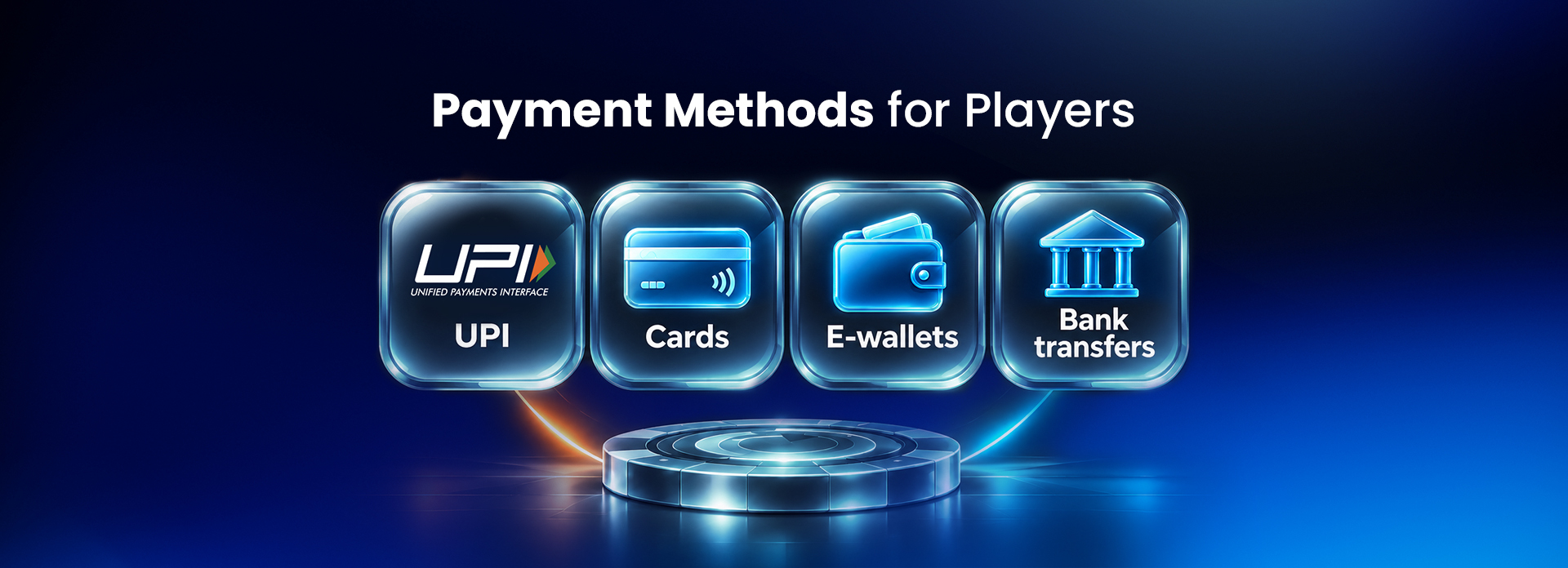
Depending on the operator and its permitted markets, relevant options may include:
· UPI: A widely used Indian digital payment system. Its availability for a particular gambling-related service must be independently confirmed.
· Cards: Availability depends on the card issuer, merchant category, transaction rules, and applicable restrictions.
· E-wallets: Supported providers may offer another payment route, subject to their own policies and geographic coverage.
· Bank transfers: Availability, processing time, and transaction limits depend on the provider and applicable rules.
· Other supported methods: Some operators offer additional regional options, but these should never be assumed to work for Indian users.
Deposits and Withdrawals Are Not the Same
A payment method that accepts deposits may not support withdrawals. Operators may impose separate verification requirements, minimum transaction amounts, processing times, or restrictions.
Before evaluating an offer, establish whether the operator clearly explains both sides of the transaction and whether its payment arrangements comply with the relevant rules.
Payment Methods for Affiliate Payouts
Affiliates should separately investigate how they receive commissions. Relevant questions include:
· Which payout methods are supported in their country of residence?
· Are commissions paid in INR, USD, EUR, or another currency?
· Are conversion fees or transfer charges applied?
· What documentation is required?
· Are minimum withdrawal thresholds imposed?
· How long does a typical payment take after approval?
Payment friction can affect both player conversion and affiliate cash flow. Evaluating both journeys provides a more realistic picture of a program's commercial suitability.
How Important Are Casino Conversion Rates and Player Retention?
Conversion rates and player retention help determine whether an affiliate program can generate meaningful returns from the traffic it receives.
A website may generate thousands of registrations but relatively few qualified depositors. Another may attract fewer visitors but produce more FTDs because its audience has stronger intent or its landing pages are better matched to the visitors' needs.
Registration-to-Deposit Conversion
The registration-to-deposit conversion rate measures how effectively registrations become depositors.
For example, if 100 eligible users register and 15 complete a qualifying first deposit, the registration-to-deposit conversion rate is 15%.
This metric can help affiliates identify differences between programs, provided the reporting definitions and measurement periods are comparable.
First-Time Depositors
FTDs are particularly important for CPA agreements because commission eligibility often depends on a player's first qualifying deposit.
The number of FTDs alone is not enough, however. Affiliates should also understand qualification criteria, minimum deposits, verification rules, and potential exclusions.
Player Retention and Lifetime Value
Retention measures whether players remain active over time. Churn refers to players who stop participating during a defined period.
For Revenue Share affiliates, retention can be especially important because recurring commissions depend on continued qualifying activity and the operator's revenue calculations.
Where available, investigate:
· Registration-to-deposit conversion.
· Qualified FTD volume.
· Average eligible revenue per player.
· Repeat activity and retention.
· Churn rates.
· NGR trends.
· Commission adjustments and reversals.
Use actual performance reports when available, and compare like-for-like periods and traffic segments. If a program does not provide retention data, acknowledge the uncertainty instead of assuming its players will generate recurring revenue.
What Should You Check in a Casino Affiliate Program's Terms and Conditions?
The affiliate agreement determines how commissions are earned, calculated, adjusted, and paid. Reviewing it before joining can help prevent disputes and unexpected reductions in earnings.
Pay particular attention to the following provisions.
Minimum qualifying deposit: Does a player need to deposit a specified amount before qualifying for CPA or Revenue Share?
Qualified player definition: Are identity verification, a minimum wagering requirement, or other conditions necessary for a player to count?
NGR deductions: Which expenses or adjustments are deducted before calculating Revenue Share? Is the calculation explained clearly?
Negative carryover: Can negative balances reduce commissions earned in subsequent reporting periods?
Chargebacks and reversals: Under what circumstances can previously credited commissions be reversed?
Dormant accounts: Can inactive affiliate accounts lose commissions or have their partnerships terminated?
Payment schedules: When are commissions calculated, approved, and paid? Are there minimum payout thresholds or processing fees?
Tracking duration: How long does a referral remain attributable to your affiliate account? What attribution rules apply if a user clicks multiple affiliate links?
Traffic restrictions: Which acquisition sources are permitted? Are there restrictions on incentivized traffic, email campaigns, redirects, or third-party promotional services?
PPC and brand bidding: Can you use paid search advertising? Are brand names, misspellings, competitor terms, or particular advertising platforms restricted?
Social media rules: Which platforms and promotional formats are permitted? Are there requirements concerning age restrictions, disclosures, or responsible-gambling messaging?
Bonus and incentive restrictions: Can you advertise bonuses or use incentives, and what wording or eligibility conditions must be disclosed?
GEO restrictions: Which countries and territories are permitted? Are there additional limitations for traffic originating in India?
Termination clauses: Can either party terminate the agreement, and what happens to outstanding commissions after termination?
Changes to commission terms: Can the operator change rates, deductions, or payment conditions? How are affiliates notified, and do changes apply prospectively or to previously generated activity?
A reliable casino affiliate program should make these provisions accessible and understandable. If an important clause is ambiguous, ask for written clarification before investing in traffic.
Is Revenue Share or CPA Better for Indian Casino Affiliates?
There is no universal winner between CPA and Revenue Share. The right model depends on the affiliate's traffic quality, acquisition costs, time horizon, and tolerance for revenue fluctuations.

When CPA May Be More Suitable
CPA may appeal to affiliates who want more predictable compensation for qualified acquisitions.
It can be useful when:
· The affiliate has measurable acquisition costs.
· The campaign generates a consistent volume of qualifying FTDs.
· The affiliate prioritizes short-term revenue visibility.
· The program's qualification criteria and payment terms are clear.
However, a CPA offer can be less attractive if qualification requirements are difficult to meet or acquisition costs exceed the commission earned.
When Revenue Share May Be More Suitable
Revenue Share can suit publishers who build long-term traffic assets and expect referred players to remain active.
It may be appropriate when:
· An SEO website attracts sustained, relevant organic traffic.
· The operator has strong player retention.
· The affiliate values recurring commission potential.
· NGR calculations and attribution terms are transparent.
The main drawback is uncertainty. Revenue Share earnings can fluctuate with player activity, operator revenue, deductions, and changes in the agreement.
When Hybrid May Be More Suitable
Hybrid arrangements combine an upfront CPA payment with recurring Revenue Share. They can balance immediate compensation against potential future earnings.
For an established casino comparison website, a hybrid deal may be worth evaluating if the publisher can demonstrate qualified traffic and negotiate suitable terms. For beginners, a simpler CPA or Revenue Share agreement may be easier to understand and monitor.
Affiliate business | Model to investigate first | Main consideration (table) |
New affiliate | CPA or straightforward Revenue Share | Understandability and qualification requirements |
SEO website | Revenue Share or Hybrid | Long-term attribution and retention |
High-volume publisher | Negotiated CPA or Hybrid | Scale and conversion quality |
PPC affiliate | CPA or Hybrid, where paid traffic is permitted | Acquisition cost and campaign economics |
Established comparison website | Revenue Share or negotiated Hybrid | Player value and negotiating leverage |
These are starting points rather than universal rules. Traffic quality, legal eligibility, and the actual terms of the offer should determine the final choice.
How to Choose the Best Casino Affiliate Program for Your Website
Selecting the best casino affiliate program requires a repeatable evaluation process.
Step 1: Identify Your Audience and GEO
Determine where your visitors live, what they search for, and which markets your business can legally target. If your website focuses on India, verify that both the operator and the affiliate agreement permit the intended traffic.
Step 2: Understand Your Acquisition Channel
An SEO publisher, social media creator, comparison website, and paid media buyer have different needs.
SEO publishers may prioritize attribution and long-term commission potential. Media buyers need explicit traffic-source permission, accurate conversion reporting, and economics that support their acquisition costs.
Step 3: Estimate Registrations and Qualified FTDs
Use historical analytics, comparable campaigns, and realistic assumptions to estimate potential acquisition volume.
Avoid choosing a program based on an assumed conversion rate that has not been validated against actual performance.
Step 4: Compare Commission Models
Calculate expected CPA, Revenue Share, and Hybrid earnings separately. Include applicable deductions, payment thresholds, and acquisition costs.
For Revenue Share, use a range of scenarios rather than assuming every referred player generates the same revenue.
Step 5: Evaluate the Player Experience
Where lawful and appropriate, review the operator's public website, registration information, payment disclosures, mobile usability, support resources, and transparency.
A high commission cannot compensate for a fundamentally poor user experience indefinitely.
Step 6: Review Tracking and Reporting
Confirm that the affiliate dashboard reports clicks, registrations, qualified FTDs, commissions, and payment status in a useful format.
Understand attribution windows and how discrepancies can be investigated.
Step 7: Verify the Contract
Check NGR deductions, negative carryover, traffic restrictions, commission changes, payment schedules, and termination provisions.
Obtain written answers to material questions before sending traffic.
Step 8: Negotiate When You Have Evidence
Once you can demonstrate consistent, compliant traffic and qualified conversions, you may have grounds to negotiate higher CPA rates, improved Revenue Share, or a hybrid agreement.
Present measurable performance data rather than relying solely on projected traffic volume.
Step 9: Diversify Carefully
Testing multiple eligible programs can help you compare conversion rates, commercial terms, and operational reliability. However, diversification should not mean spreading traffic without sufficient data or violating exclusivity clauses.
A smaller portfolio of well-evaluated partnerships is often easier to monitor than a large collection of poorly understood offers.
Common Mistakes Indian Casino Affiliates Should Avoid
Even experienced publishers can undermine their results by overlooking the details behind an attractive affiliate offer.
1. Choosing a program solely because it advertises “up to 50% RevShare.” The actual rate, eligible revenue, and deductions matter more than the headline.
2. Ignoring NGR deductions. Expenses deducted before commission calculations can materially change earnings.
3. Sending traffic to an unsupported GEO. An operator may reject traffic or exclude players from commission eligibility.
4. Assuming payment methods are available. Verify both player transactions and affiliate payouts.
5. Skipping the affiliate agreement. Important restrictions may be buried in the terms.
6. Overlooking negative carryover. Understand how negative balances affect future commissions.

7. Ignoring player retention. Registration volume alone is a poor measure of long-term Revenue Share potential.
8. Failing to monitor FTD conversion rates. Track the full acquisition funnel rather than clicks alone.
9. Relying entirely on one program. Where agreements permit, a diversified portfolio can reduce dependency on one commercial partner.
10. Using prohibited PPC or promotional methods. Violations can lead to withheld commissions or termination.
11. Assuming international offers are automatically available in India. Check GEO restrictions and applicable legal requirements.
12. Failing to review updated terms. Rates, accepted markets, payment conditions, and promotional rules may change.
The most sustainable casino affiliate marketing strategy combines careful partner selection, transparent disclosures, compliant promotion, and ongoing performance analysis.
Frequently Asked Questions About Casino Affiliate Programs in India
What is the best casino affiliate program in India?
The best casino affiliate program in India depends on your audience, traffic source, eligible GEO, and preferred commission model. Compare CPA and Revenue Share terms, tracking reliability, payment conditions, operator reputation, player retention, and India-specific eligibility.
There is no single program that is automatically best for every affiliate. Verify current terms and legal eligibility before joining.
How much can casino affiliates earn in India?
Casino affiliate earnings vary according to traffic volume, audience intent, qualified FTDs, commission rates, acquisition costs, and player retention.
CPA affiliates earn according to qualifying acquisition volume, while Revenue Share affiliates depend on the eligible revenue generated by referred players. Hybrid deals combine these mechanisms.
Income is not guaranteed, and a large audience does not necessarily translate into profitable traffic.
Which is better, CPA or Revenue Share?
CPA offers a defined payment for each qualified acquisition, making it useful for affiliates seeking more predictable compensation. Revenue Share can generate recurring commissions when referred players remain active. Hybrid deals combine both approaches.
The best option depends on traffic quality, acquisition costs, retention, and contract terms.
Can Indian affiliates promote international casino brands?
That depends on the operator's geographic restrictions, the affiliate agreement, and the laws applicable to the relevant services and audience.
An international brand's willingness to accept affiliate applications does not establish that its services can lawfully be promoted to users in India. Check the applicable requirements and obtain qualified legal advice when necessary.
Do casino affiliate programs pay monthly?
Many affiliate programs use monthly payment schedules, although some operate weekly, biweekly, or under other arrangements.
Check the payment threshold, commission approval process, payout method, processing fees, and any verification requirements. Do not assume that all programs follow the same schedule.
What is FTD in casino affiliate marketing?
FTD stands for First-Time Depositor. It generally refers to a player who makes their first qualifying deposit with an operator.
FTDs are particularly important for CPA deals because commissions often depend on meeting specific qualification requirements.
What is NGR in casino affiliate marketing?
NGR stands for Net Gaming Revenue. It is a revenue measure calculated according to the operator's definition and the deductions permitted under the affiliate agreement.
Because Revenue Share is often calculated as a percentage of NGR, affiliates should understand precisely how the figure is calculated before comparing commission offers.
Can I join multiple casino affiliate programs?
Potentially, yes. Some affiliates work with multiple operators or networks to diversify partnerships and compare performance.
However, review exclusivity clauses, brand-bidding restrictions, promotional rules, and GEO requirements before joining or promoting additional programs.
What is the difference between a casino affiliate program and a casino affiliate network?
A casino affiliate program typically allows publishers to partner with a particular operator or brand. A casino affiliate network may connect publishers with multiple advertisers through a shared platform.
Networks can simplify access to offers and reporting, but their fees, commission structures, and responsibilities vary. Compare the underlying operators and terms rather than assuming a network is automatically better.
What should I check before promoting a casino affiliate offer in India?
Confirm that the operator and offer are eligible for the intended audience, review applicable laws and GEO restrictions, and read the affiliate agreement.
Then evaluate commission calculations, payment conditions, tracking, player experience, advertising restrictions, and responsible-gambling requirements. Avoid promoting services whose legal eligibility you cannot establish.
Conclusion
The best casino affiliate program in India isn't necessarily the one advertising the biggest commission. It's the program that combines competitive commercial terms, reliable tracking, transparent calculations, appropriate GEO support, clear payment conditions, and a credible player experience.
For Indian affiliates, the most effective approach is to compare programs systematically. Look beyond the headline CPA or Revenue Share percentage. Examine NGR deductions, negative carryover, FTD qualification requirements, attribution rules, and the operator's ability to serve the intended audience legally.
Your traffic source matters, too. SEO publishers may prioritize long-term attribution and player retention, while paid media affiliates may need predictable acquisition economics and explicit campaign permissions. Hybrid deals can offer a middle ground when the underlying terms make commercial sense.
Before committing resources, verify the current affiliate agreement, assess the full conversion journey, and use actual performance data wherever possible. Once you can demonstrate compliant, high-quality traffic, negotiate from evidence rather than promises.
A carefully selected affiliate partnership can support a more sustainable publishing business—but success depends on the quality of the partnership, realistic financial analysis, and continued attention to compliance.
Related reading

Best Revenue Share Casino Programs for Affiliates in 2026
Revenue share remains the gold standard for long-term passive income in iGaming. Compare the top casino affiliate programs of 2026, evaluating rev share rates, negative carryover terms, payout reliability, and player retention.

Best B2B Providers for Affiliates in 2026
Scaling a performance marketing operation requires robust B2B technology. Compare the leading affiliate tracking software, global payment infrastructure, and automated KYC services for 2026.