
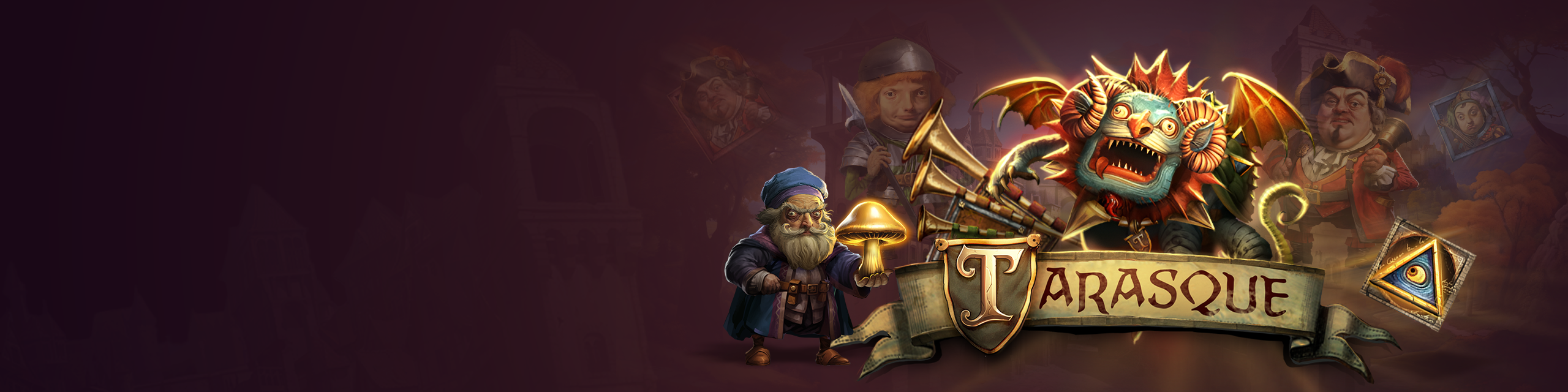

Unlike previous La Part Maudite entries such as SEW or Kenneth Must Die, Tarasque does not earn its place here through body horror, sexual provocation or deliberate shock value.
There is no suburban BDSM dungeon. No human body being stitched into something it should never become. No contemporary political satire.
Instead, Tarasque by Print Studios earns its place through something much rarer in online slots: an unusually rich combination of European folklore, medieval religious legend, visual art, festival culture, grotesque comedy and genuinely experimental mechanics. Print Studios itself says the game was inspired by old European myths and legends. Print Studios
And unlike plenty of historical-themed slots, it does not feel like someone simply searched “medieval fantasy” and filled the reels with swords and castles.
Tarasque feels closer to a strange medieval puppet theatre brought to life.
Tarasque - official Print Studios page
Tarasque: Quick Facts
Feature | Details |
Provider | Print Studios |
Release | 22 February 2024 |
Grid | 8×8 |
Win System | Cluster Pays |
RTP | 96.30% |
Feature Bet RTP | 96.46%–97.02% |
Volatility | 4/5 |
Hit Frequency | 31.71% |
Bet Range | €0.10–€50 |
Max Win | 20,000x |
Max Win Probability | 1 in 2,778,550 |
Feature Bet 5 Max Win Probability | 1 in 9,370 |
These figures come from the official game sheet supplied by Print Studios. Tarasque - Gamesheet
One small discrepancy is worth noting: Print Studios' current public product page displays 96.32% RTP, while the official game sheet supplied for the game lists 96.30%. This review follows the game sheet. Print Studios
The Monster France Learned to Celebrate
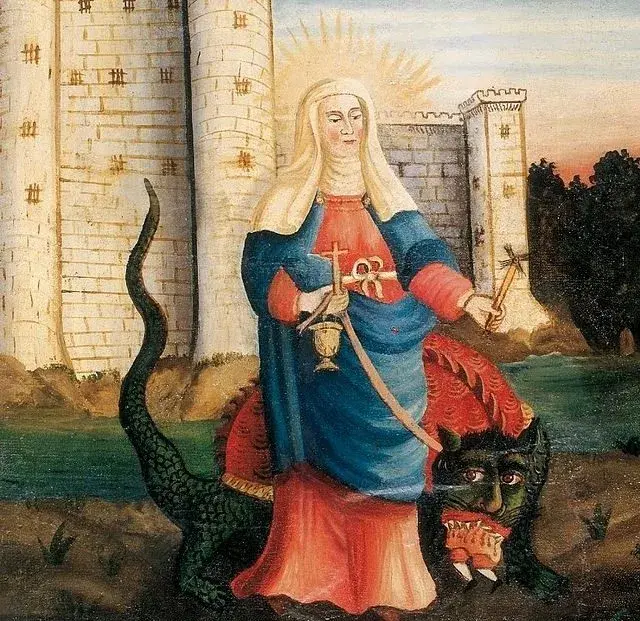
Before it became a slot mechanic, the Tarasque was a monster of Provençal legend.
Medieval traditions surrounding Saint Martha describe a hybrid creature terrorizing the region around the Rhône. The Tarasque combines characteristics of several animals - dragon, lion, turtle and other monstrous forms depending on the version - and is eventually subdued by Saint Martha, traditionally through holy water, the cross and religious authority. Medieval versions of Martha's life, including the enormously influential Golden Legend, helped establish the story. Prairial Publications
The delightful contradiction is that Martha is much better known to most Christians as the practical Biblical woman concerned with hospitality and household work.
Medieval folklore apparently decided that was not enough.
She also needed a dragon.
Saint Martha and the medieval dragon tradition - U.S. Catholic
Print Studios preserves the core relationship. Saint Martha appears as one of the game's central high-value symbols, complete with halo and holy vessel, while the Tarasque is the creature around which the entire mechanical structure eventually revolves.
But the game is not really interested in retelling the legend faithfully.
It wants to throw a festival.
The Monster Did Not Stay Dead
This is where the real cultural history becomes more interesting.
The Tarasque did not disappear into medieval manuscripts. It became part of Tarascon's civic identity.
Large Tarasque effigies have been carried through public festivities, turning a terrifying legendary monster into something the community repeatedly brings back to life. Tarascon still holds Fêtes de la Tarasque, complete with a grand Tarasque procession, medieval-themed activities and renewed connections with the Saint Martha tradition. Tarascon
The wider tradition of processional giants and dragons in Belgium and France - including Tarascon - is recognized by UNESCO as intangible cultural heritage. UNESCO describes these festivals as mixtures of procession, legend, costume, music, religious ceremony and public spectacle in which giant creatures become symbols of their communities. ICH UNESCO
The modern Fêtes de la Tarasque - City of Tarascon
Processional Giants and Dragons - UNESCO
That gives the slot a much more interesting cultural lineage:
monster → Christian legend → civic symbol → festival attraction → slot character.
The Tarasque was once something society needed to destroy or tame.
Eventually, society decided it would rather parade it through the streets.
Print Studios simply gives it another stage.
Holy Water, Berserk Broth
The game's intro movie makes its intentions clear immediately.
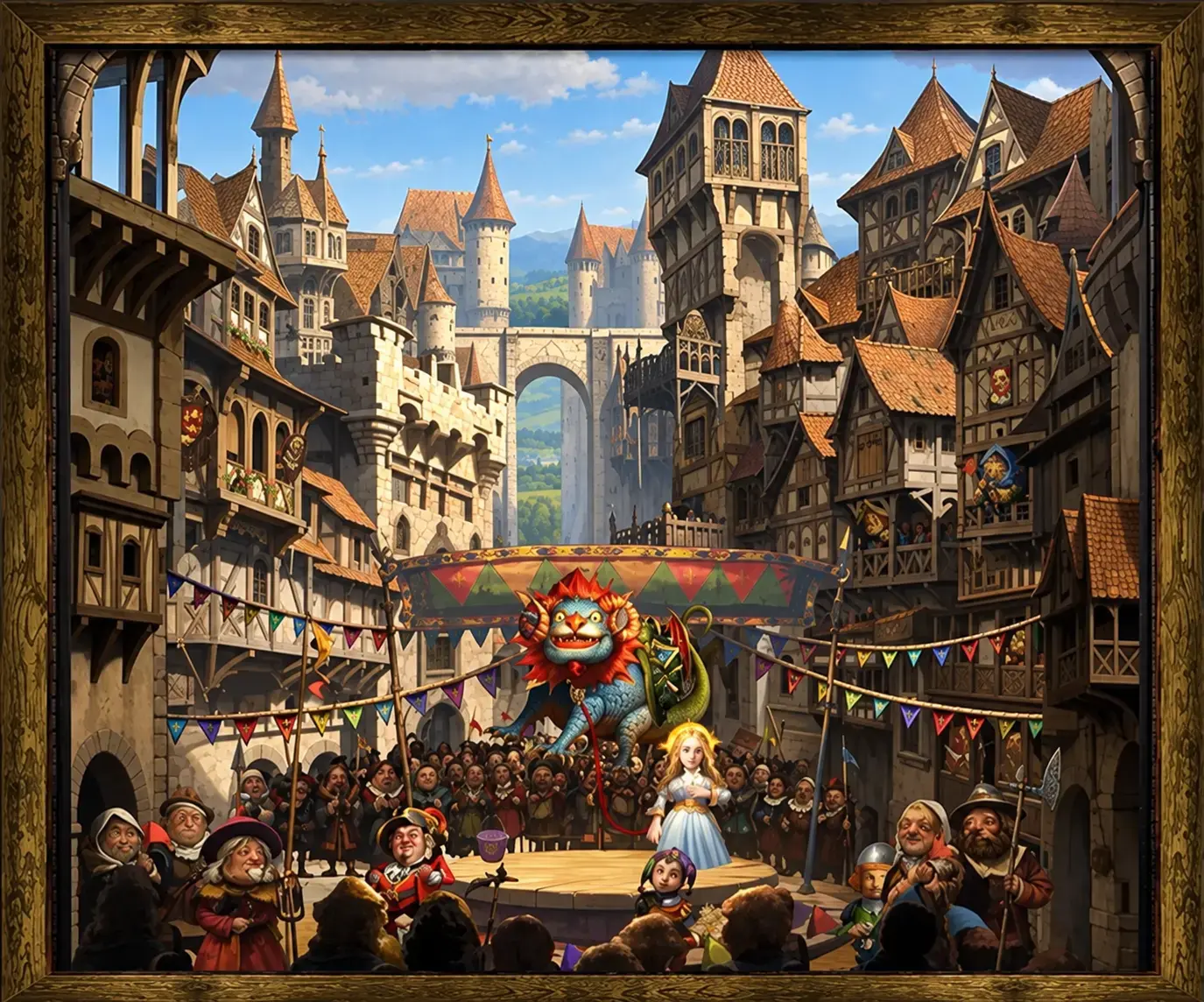
Print Studios relocates the legend to the fictional town of Tarragon, where villagers gather for an annual festival to watch Saint Martha perform with her already-domesticated Tarasque. The official game sheet presents exactly this setup: the celebration is interrupted when the village Mage creates a scheme designed to turn the festivities upside down. Tarasque - Gamesheet
Then the sacred story becomes slapstick.
The Mage replaces Martha's holy water with Berserk Broth. The Tarasque gets the wrong drink, loses control, begins devouring everything around it and eventually has to expel what it has swallowed.
This is not exactly The Golden Legend.
And that is the point.
In the medieval legend, Martha brings chaos under control.
In Print Studios' version, civilization has already domesticated the monster, transformed it into entertainment - and then accidentally wakes the damn thing back up.
The Whole Town Is Performing
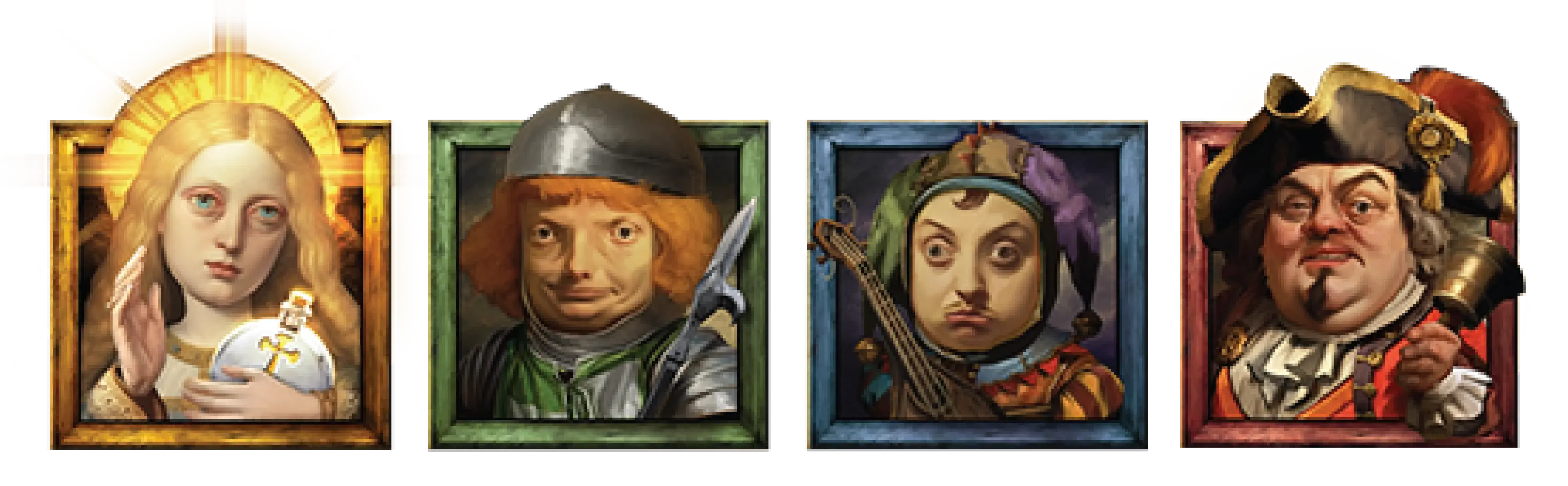
The symbol set makes Tarasque feel less like a collection of medieval objects and more like the cast of a public pageant.
There is Saint Martha.
There is a guard representing civic order.
There is a heavily caricatured town crier, perfectly suited to a game obsessed with public announcements and fanfare.
And then there is the Jester, playing a small medieval stringed instrument resembling a gittern.
Jesters were not simply decorative clowns. Medieval entertainers could function as musicians, storytellers, comedians, performers and even messengers, while later French festival culture included organized groups of fools performing publicly at fairs and celebrations. History Extra
The musical choice is equally fitting. Gitterns and related plucked instruments appear throughout medieval European visual culture; The Metropolitan Museum of Art, for example, holds a French fifteenth-century sculpture of a musical angel playing a gittern. The Metropolitan Museum of Art
Court jesters in medieval life - HistoryExtra
A fifteenth-century French gittern player - The Metropolitan Museum of Art
This is one reason the game's visual world works so well.
Nobody feels randomly selected.
Saint, fool, guard, crier, magician and monster all belong to the same theatrical universe.
A Medieval Puppet Theatre
Visually, this might be Tarasque's greatest achievement.
The game does not attempt photorealistic medieval France. Its fictional Tarragon is an exaggerated European town of towers, timber buildings, stone arches and distant castles, presented with the softness of an old painted backdrop.
The characters look almost like articulated figures from an elaborate puppet show.
Faces are distorted.
Bodies are slightly ridiculous.
Expressions are theatrical.
The Tarasque itself is particularly successful. Print Studios avoids making it a generic fantasy dragon. It is a deliberately hybrid, grotesque thing: horns, wings, armor-like shell, claws, reptilian limbs, spikes, curling tail and enormous staring eyes.
It is threatening enough to remain a monster but ridiculous enough to become a mascot.
That is almost exactly what centuries of folklore had already done to the creature.
High Art Is Not Safe Either
Tarasque also enjoys dragging respectable visual culture into the joke.
The Wild symbol is a triangular all-seeing eye, unmistakably recalling the visual language of the Eye of Providence, but within the game it primarily functions as an image of supernatural observation and transformation.
That connection becomes stronger because Morphing is central to the mathematics.
More explicit is the game's use of Michelangelo's Creation of Adam.
During one of the celestial animations, the reclining figure of Adam is unmistakably recreated and sent drifting through the slot as part of a multiplier event.
The original Sistine Chapel fresco centers on the approaching fingers of God and Adam, the moment through which life is transmitted. Vatican Museums
In Tarasque, one of the most recognizable images in Western religious art becomes part of a slot feature.
Michelangelo's Creation of Adam - Vatican Museums
It is difficult not to admire the audacity.
Michelangelo gives you a multiplier.
And somehow it does not feel cheap.
That may be the most impressive aspect of Print Studios' approach. The game constantly moves between Christian imagery, folklore, Renaissance art and vulgar comedy, but rarely feels as though it is laughing at the source material.
It seems to genuinely enjoy it.
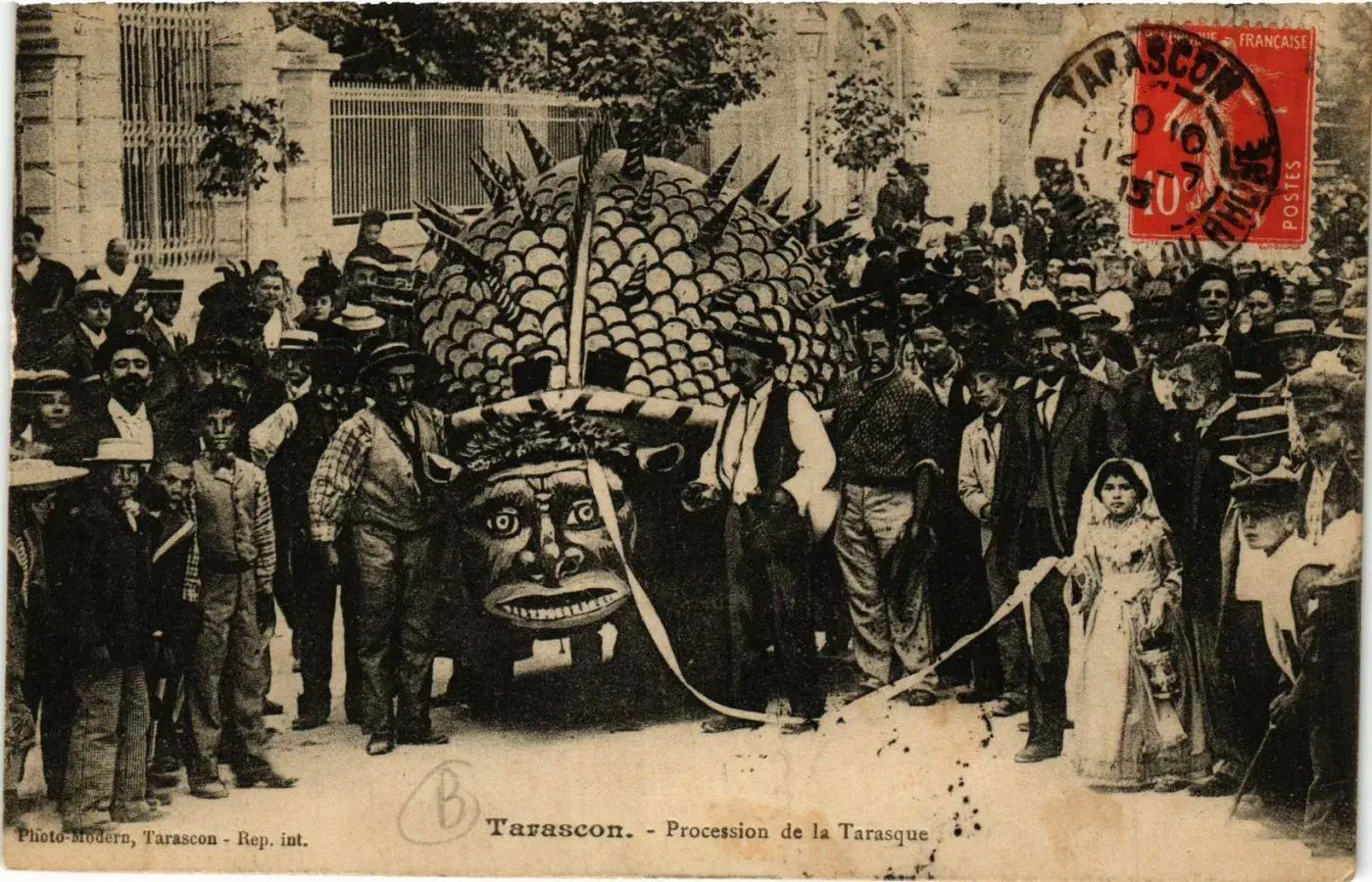
The Tarasque procession in Tarascon, France, early 20th century. Vintage postcard by Photo-Modern, Tarascon.
The Snail in the Margins
Even one of the smallest low-paying symbols deserves attention.
Among the familiar horseshoe, clover and lemon sits a snail.
That may simply be an appropriately medieval-looking creature, and we should be careful not to manufacture references Print Studios has never confirmed. But snails occupy a famously strange place in medieval manuscript marginalia.
Thirteenth- and fourteenth-century manuscripts repeatedly depict armed knights confronting enormous snails. The exact meaning remains debated; proposed explanations range from social satire to class imagery, sexuality and simple visual absurdity. The British Library is appropriately cautious: medieval marginal imagery does not always have one stable interpretation. British Library
Knight v Snail - British Library
Since Tarasque never explicitly stages its guard fighting the snail, calling this a direct reference would go too far.
But in a game so interested in medieval grotesque imagery, its presence certainly feels at home.
The Monster Literally Eats the Slot
Now, let’s turn to the mechanics.
Fortunately, Tarasque is not only an art-history joke with a spin button.
Its most important mechanical idea is also its most thematically successful one.
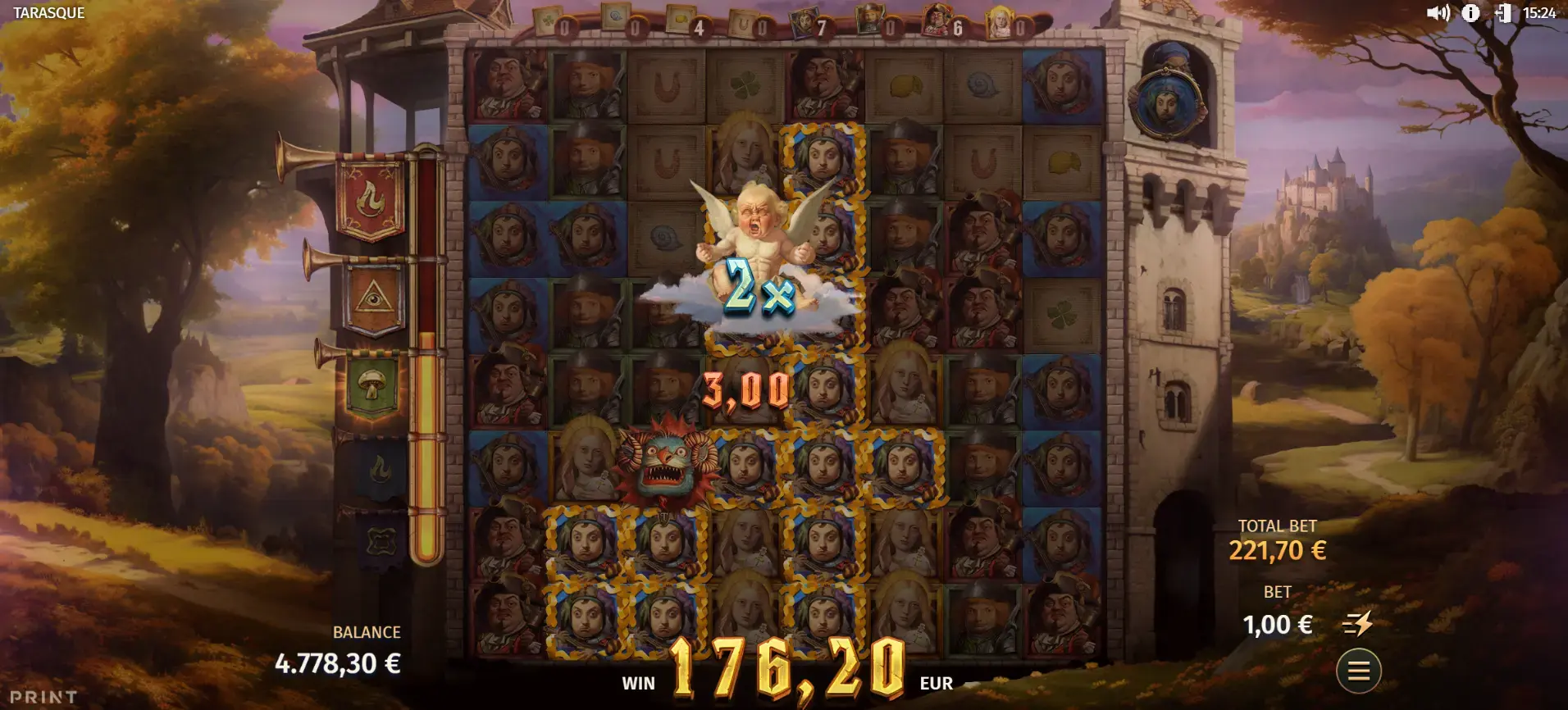
The official game sheet explains that when the first Progressive Feature activates, the Tarasque awakens, enters the grid as a Wild and begins devouring neighboring winning symbols. Eventually it regurgitates the symbols it has stored, potentially filling large areas of the board. That is excellent thematic design.
The Tarasque is not represented by a monster symbol while an unrelated multiplier happens somewhere else.
The legendary appetite becomes the mechanic.
The creature eats the slot.
And the game remembers what it ate.
This is exactly the kind of relationship between concept and mathematics that La Part Maudite looks for.
Morphing Clusters
Even before the beast fully wakes up, the 8×8 grid has its own unusual structure.
Every spin can use the Morph system, selecting a symbol and transforming an entire connected cluster into a neighboring symbol. That can create new clusters and further chain reactions. The mechanic also connects naturally to the Mage.
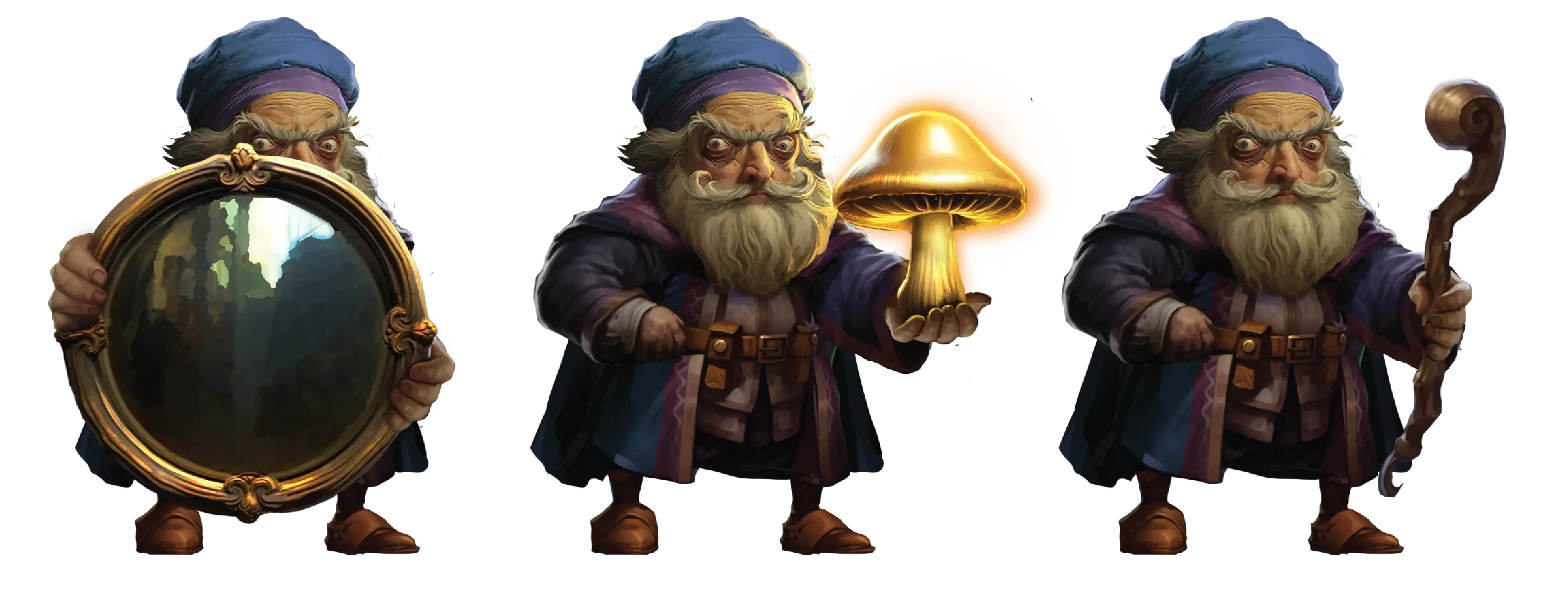
He is not simply the villain of the intro. Transformation is his entire vocabulary.
His Mage's Morph Progressive Feature can add up to 45 morphing symbols to the board. Tarasque - Gamesheet
The story gives him magical interference.
The mechanics give him transformation.
Again, theme and mathematics speak the same language.
No Bonus Room - the Festival Just Gets Worse
One of Tarasque's most unusual decisions is what it doesn't have.
There is no traditional Free Spins round.
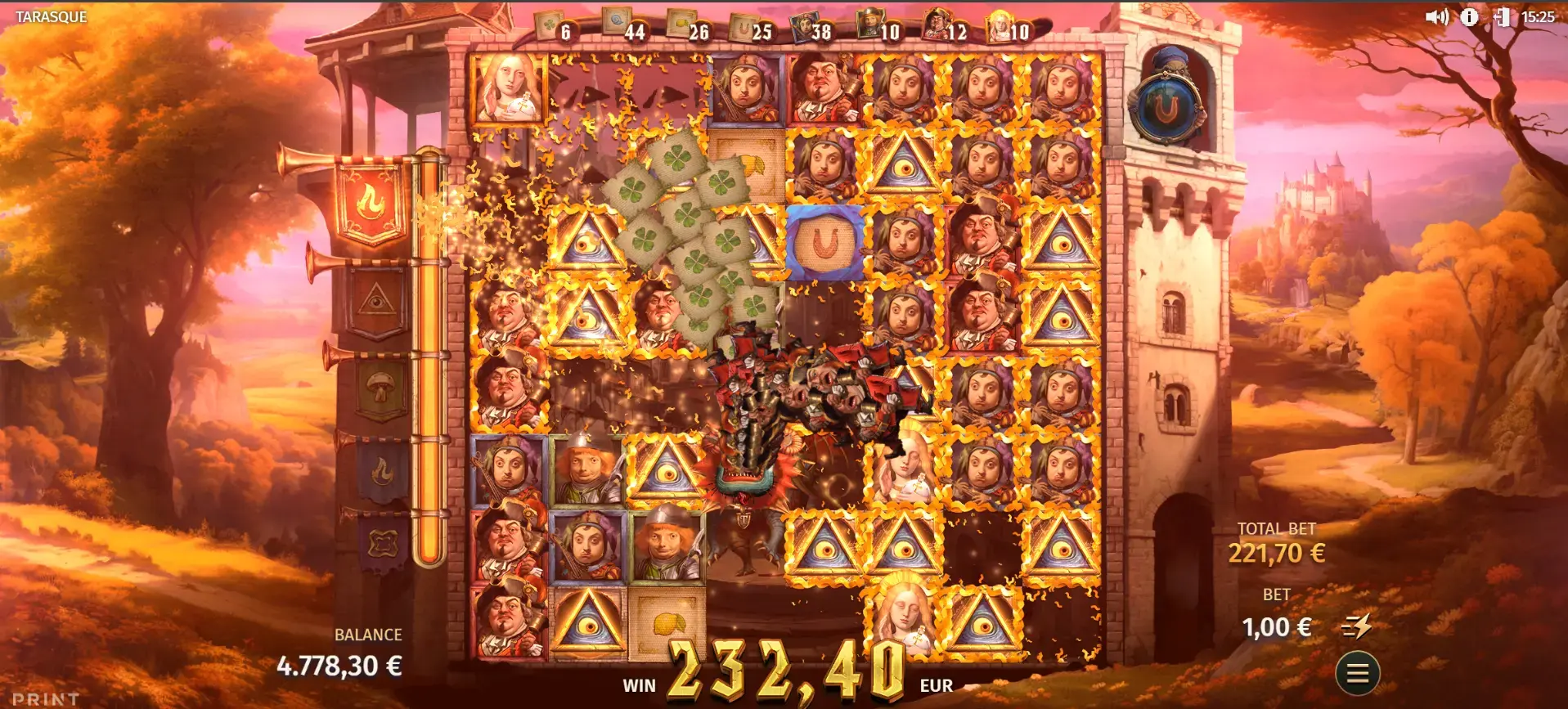
Instead, every win charges a five-stage Progressive Feature meter. Each stage can trigger one of four features, growing stronger as progression continues.
Wild Spikes can place up to 24 Wilds.
Blazing Gaze removes low-paying symbols across cascades.
Mage's Morph introduces increasing numbers of morphing symbols.
Bulking Beast physically grows the Tarasque until it can occupy an enormous 4×4 area of the grid.
Visually, even the meter belongs to the world. It is built from stacked heraldic banners and trumpets, as though every new feature level is another announcement in the town festival.
You do not leave the base game to enter the bonus.
The festival itself simply gets further out of control.
The Grotesque Gets Bigger
Bulking Beast gradually turns the Tarasque into something approaching a grotesque medieval bodybuilder.
At the highest level, after the Mage gives the creature its maximum growth, the Tarasque becomes enormous on the reels and briefly stands fully exposed - except for its crotch, which is deliberately pixelated.
The same game that borrows Christian saints, medieval folklore and Michelangelo eventually gives us an oversized monster whose genitals need censorship pixels.
The Max Win sequence takes the joke in a different direction. Instead of repeating the same gag, the fully powered Tarasque fires lasers from its eyes and then fall asleep, snoring, pushing the creature even further from medieval legend and into absurd cartoon spectacle.
In Rabelais and His World, Bakhtin examined medieval and Renaissance traditions where official seriousness could mix with laughter, feasting, bodily excess, degradation and grotesque imagery. (MIT Press)
Tarasque assembles an almost perfect collection of those elements: a saint, a fool, a festival, an oversized monster, excessive eating, vomiting, regurgitation, bodily comedy, sacred imagery and public spectacle.
There is no need to bury the game under theory, though. The central idea is simple:
In carnival, the sacred and ridiculous do not need to remain separate.
Neither do they in Tarasque.
The Soundtrack Knows Exactly Where It Belongs
The music may be one of the game's cleanest creative decisions.
Its medieval-inspired soundtrack fits so naturally with the jesters, fanfares, architecture, religious imagery and puppet-theatre visuals that it barely feels like a separate layer.
Some slot soundtracks are obviously sitting on top of the game.
Tarasque's feels as though it lives inside the town.
Soundtrack integration: 10/10.
The Theme Actually Survives Contact With the Gameplay
This has become an important test for La Part Maudite.
Plenty of visually ambitious slots lose their identity as soon as the reels begin moving. Beautiful characters become ordinary high pays. Complicated lore becomes decoration around familiar mechanics.
Tarasque mostly avoids that problem.
The Mage transforms symbols.
The Tarasque eats them.
The beast physically grows through Bulking Beast.
The public festival becomes the Progressive meter.
Celestial imagery produces blessings and multipliers.
The monster's final digestive act becomes an actual mechanical climax.
So the folklore is not merely illustrated.
It participates in the mathematics.
The Appeal
Exceptional visual quality with a distinctive medieval puppet-theatre aesthetic.
Rich European folklore references that reward closer attention without making the game feel academic.
Original mechanics, especially Morphing Clusters and the Progressive Feature system.
The Tarasque’s Devour-and-return mechanic is one of the strongest examples of theme directly shaping gameplay.
Excellent animation, presentation and overall production quality.
The game feels carefully designed rather than assembled from unrelated historical references.
The Damage
The Progressive Feature structure can become drawn out and may feel repetitive over longer sessions.
Its layered mechanics will appeal to some players, but others may feel they are waiting for the game to finish performing.
It has less immediate shock or emotional impact than previous La Part Maudite entries such as SEW, Kenneth Must Die and Black Friday ([INTERNAL LINK: Black Friday Slot Review]).
Almost every individual element works extremely well, but the whole still falls slightly short of becoming something greater than the sum of its parts.
La Part Maudite Final Spin - 8.5/10
Tarasque is probably one of the least shocking games we have covered in La Part Maudite, yet it is absolutely one of the most culturally interesting.
Its value comes from richness rather than provocation.
Print Studios takes a strange Provençal monster, Saint Martha, European festival culture, medieval fools, Renaissance religious art and the grotesque tradition, then folds them into a mechanically ambitious grid slot without turning the result into a lifeless history lesson.
The game is funny without becoming cheap.
Beautiful without becoming sterile.
Historically inspired without pretending to be historically accurate.
And mechanically experimental without completely abandoning the basic pleasure of watching symbols connect and explode.
It comes close to what could be called a total work of slot art - a game where visual design, folklore, animation, music and mechanics become one inseparable object.
Close.
But not completely.
That missing final synthesis keeps it below the very highest La Part Maudite scores.
Still, few slots would even justify asking the question.
Tarasque does not shock its way into La Part Maudite. It earns its place by showing how much culture, craft and strange European history can fit inside an 8×8 grid.
La Part Maudite score: 8.5/10.

The series title is inspired by Georges Bataille's 1949 work La Part maudite.
Related reading

Transformers Slot Review: When Beast Mode Meets the Culture War
We continue La Part Maudite, our series about the most vile, controversial and culturally interesting slot games - titles worth discussing not only for RTP and max win, but for what they do with social stereotypes, identity, politics and popular culture.
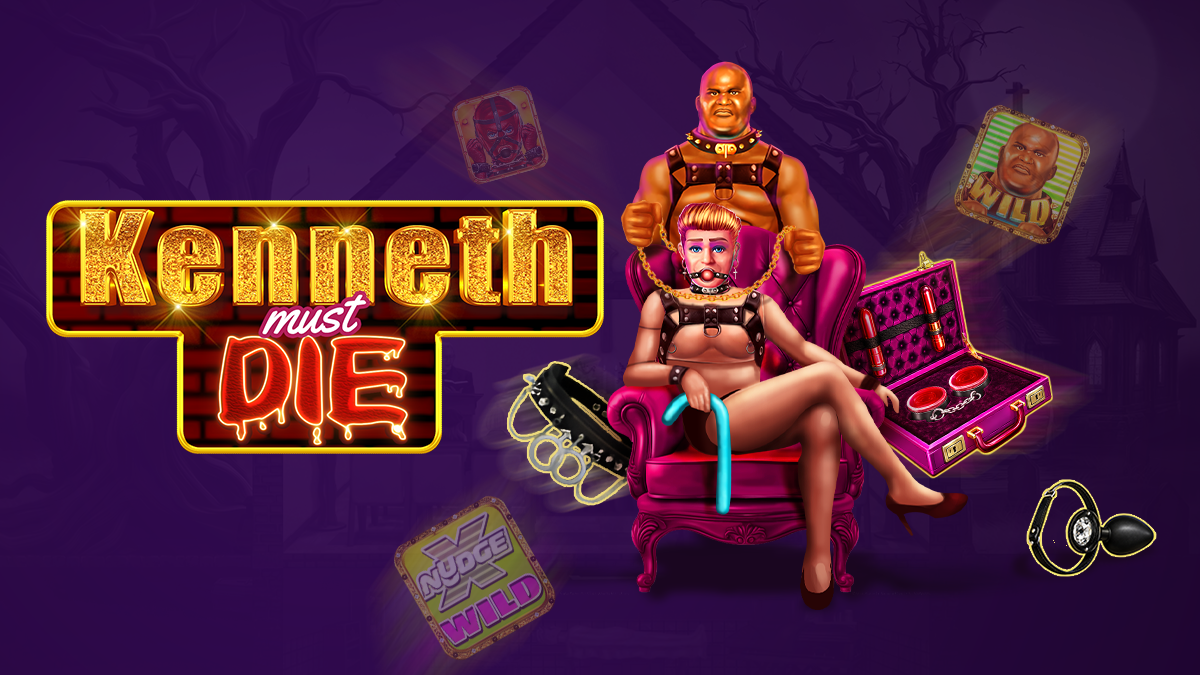
Kenneth Must Die Slot Review: The Perfect Life Has a Basement
Our second entry is Kenneth Must Die by Nolimit City, and this time the target is not consumer society but something more personal: the grotesque double life of the suburban middle-class life.
