
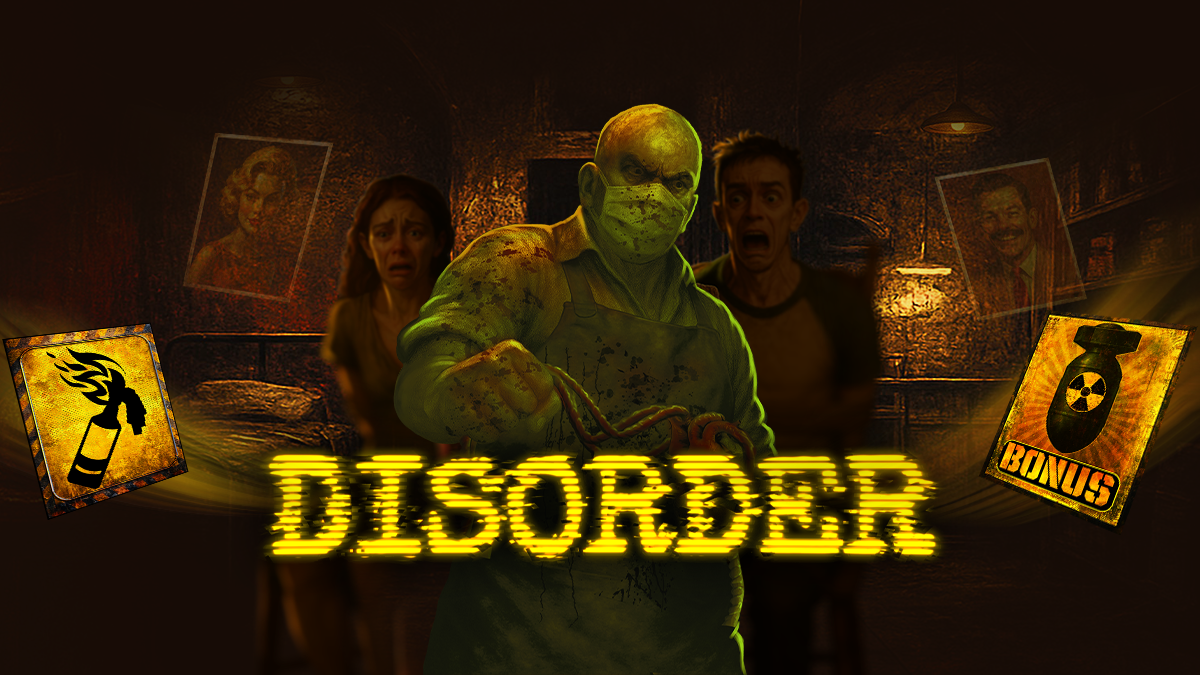
Disorder Slot Review: The State of Emergency Comes Home
We continue La Part Maudite, our series about slots worth discussing not only for RTP, volatility and max win, but for what they do with politics, psychology, culture, violence and the ideas hidden behind the reels.
This time we have Disorder by Nolimit City.
At first glance, the premise looks familiar. A respectable American father. A wife. Children. A dog. A comfortable home. A car outside. Television, telephone, refrigerator, swimming pool. Everything required for the picture of a successful postwar middle-class family.
Then the alarm goes off.
Unlike SEW, where the human body becomes raw material, or Kenneth Must Die, where respectable suburban life hides a voluntarily chosen sexual double life, Disorder builds its horror around something more political and psychological.
John does not simply have another life underneath the house.
The outside world enters the house with him.
Nuclear fear turns protection into emergency. Emergency turns the father into an authority. And as the game becomes mechanically stronger, the man who was supposed to protect his family becomes increasingly violent, unstable and monstrous.
Nolimit City officially presents Disorder as the origin story of Mental and Mental II: the moment before the asylum, when John and the apparently perfect Smith family fall apart. Nolimit City
Disorder: Quick Facts
Feature | Details |
Provider | Nolimit City |
Release Date | 4 November 2025 |
RTP | 96.11% / 94.12% / 92.12% |
Layout | 4-3-4-3-4-3 |
Starting Win Ways | 1,728 |
Volatility | 8/10 - High |
Main Mechanics | xBomb®, Infectious xWays® |
Max Win | 23,500x |
Free Spins | 1 in 270 |
Bet Range | €0.20–€100 |
Feature Buy | Yes |
The Perfect Family Before the Alarm
The first thing Disorder needs is order.
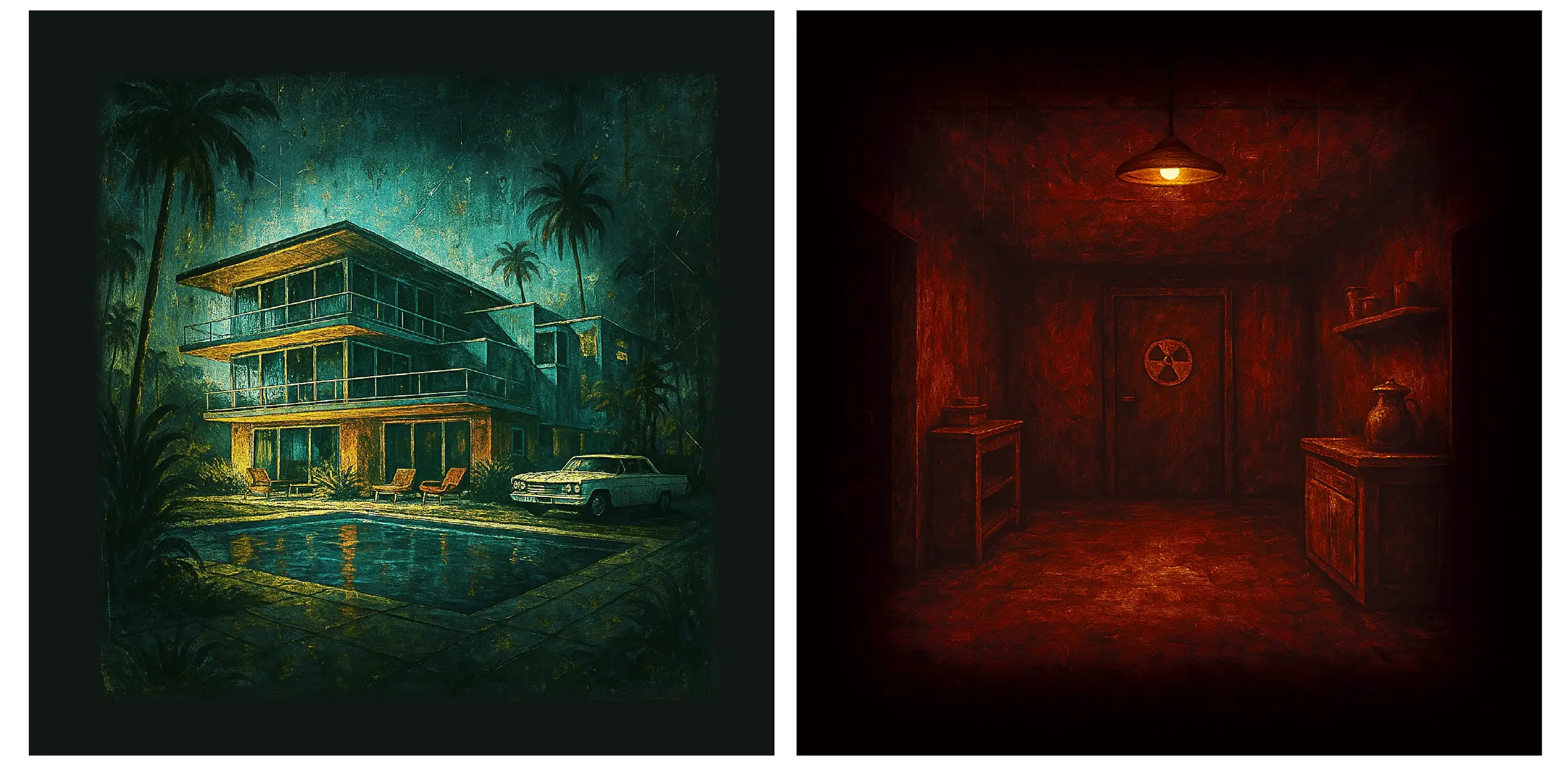
Its opening world is deliberately attractive. The Smiths look like an idealized American family living inside a piece of postwar advertising: smiling parents, clean children, domestic appliances, a modern house and the material signs of stability.
That matters because the Cold War was not experienced only through missiles, military bases and presidential speeches.
It also entered the home.
Historian Elaine Tyler May describes postwar American family culture through the idea of domestic containment. Cold War containment was aimed outward at communism and atomic proliferation, but May argues that another kind of containment took place inside the home: domestic stability, marriage and family life became closely connected to ideas of security and social order.
Disorder begins inside exactly that fantasy.
The house is safe.
Father provides.
Mother smiles.
Children behave.
The family remains together.
Until security itself becomes the thing that destroys them.
The Fallout Shelter Under the American Dream
Cold War civil defense made the relationship between the nuclear threat and private family life very literal.
The Smithsonian's preserved Family Fallout Shelter explains the logic clearly: civil-defense policy assumed that enough preparation could allow the American family - and through it the country's broader social and political fabric - to survive nuclear attack. Private shelters therefore transformed the family home into a tiny defensive institution. This makes John's descent into the bunker much more interesting than a generic horror cliché.
He takes his family underground to protect them.
That word matters.
The bunker initially represents safety.
But the deeper the family goes into John's protective space, the less protection means safety and the more it begins to mean control.
The nuclear threat exists somewhere outside.
John is inside.
And eventually the father becomes more dangerous than the bomb.
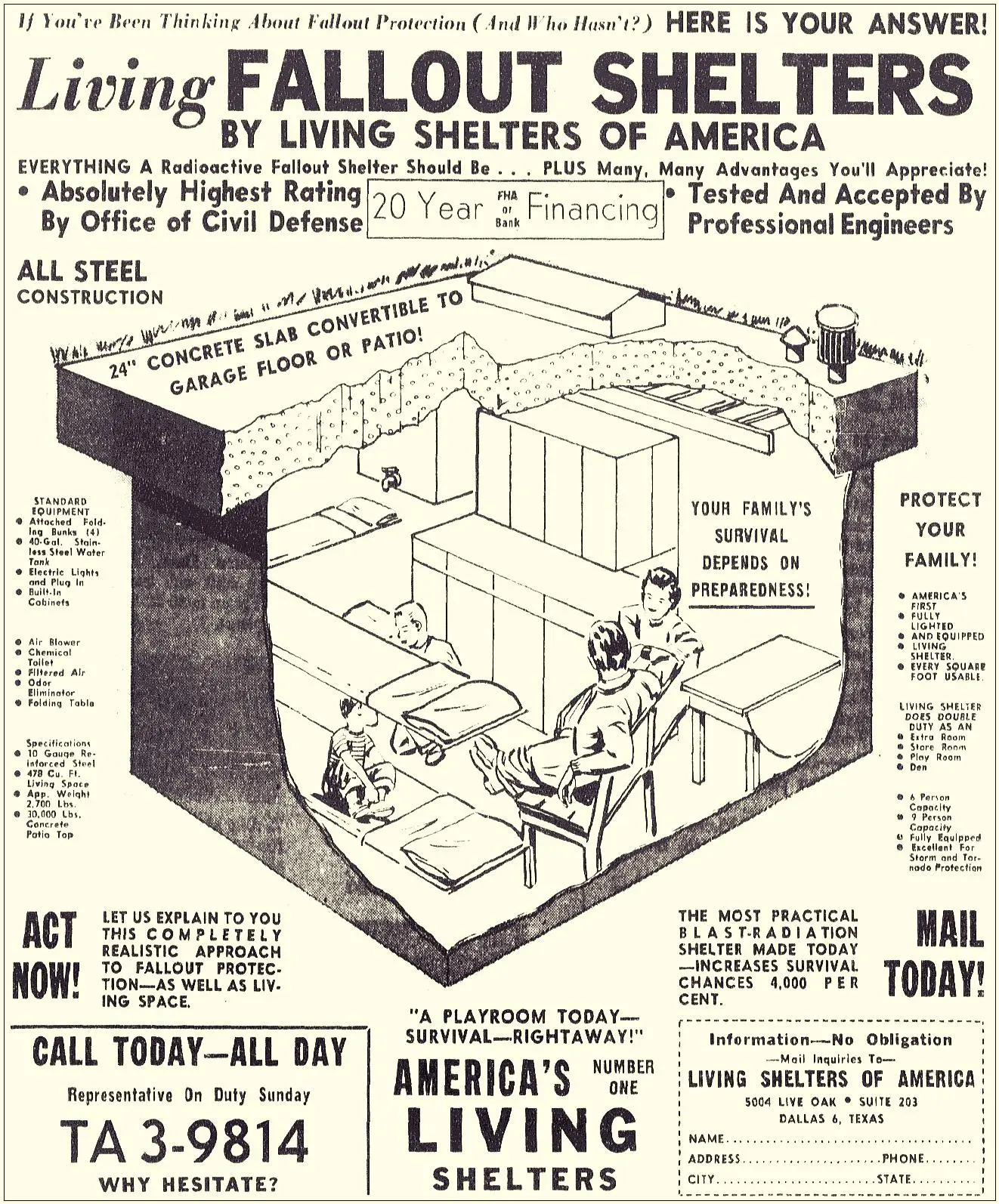
Living Shelters of America fallout-shelter advertisement, 1961.
The State of Emergency Moves Into the Basement
This is where Disorder becomes politically interesting.
The following is an interpretation rather than something Nolimit City explicitly states, but the game invites it.
Political theorist Carl Schmitt, in Political Theology, famously connected sovereignty with the exceptional situation: ordinary rules cannot completely anticipate an emergency, so someone must ultimately possess the authority to decide what happens when normal order breaks down. John begins in the most traditional position of household authority.
Then comes an existential threat.
Normal life can no longer continue.
The family follows him into the bunker because the emergency apparently requires someone to make decisions.
And once the family has entered the exceptional space, the balance changes.
The protector becomes the sovereign of a tiny underground state.
And his state becomes tyrannical.
Giorgio Agamben later developed the idea of the state of exception around precisely this danger: emergency measures that are supposed to be temporary can become normalized, allowing exceptional power to become an ordinary condition. Disorder miniaturizes that problem inside one household.
The bunker is supposed to be temporary.
John's emergency never ends.
The Father Becomes the State
That makes John more interesting than another Nolimit City psycho with a weapon.
He can be read as a miniature version of political authority under permanent emergency.
The external threat gives him legitimacy.
He promises protection. Protection grants authority. Authority removes normal limits.
The State does not literally walk through the Smith family's front door.
Instead, the logic of emergency enters the home and reorganizes the relationships inside it.
The peaceful family becomes a population to manage.
The house becomes a bunker.
The bunker becomes a prison.
And the father becomes something closer to a ruler than a parent.
That reading becomes even darker because the person exercising power is not originally presented as evil.
John is introduced as a man of routine - a devoted father, loyal husband and symbol of domestic order. After returning home, however, something has changed; his violence destroys the family image that defined him. The game's horror therefore does not begin with a monster entering the home.
It begins with the protector changing function.
The Nuclear Family Meets the Nuclear Bomb
There is an almost too-perfect collision at the center of Disorder.
The game gives us the nuclear family surrounded by imagery of literal nuclear destruction.
Not because the two uses of “nuclear” historically mean the same thing, but because visually the coincidence becomes irresistible.
On one side:
father
mother
son
daughter
dog
house
car
television
swimming pool.
On the other:
radiation symbols
bombs
bunkers
warning systems
fire
Nuclear Wilds
xBombs.
The bomb threatens the family from outside.
John destroys it from inside.
The game then does something particularly cruel with its symbols.
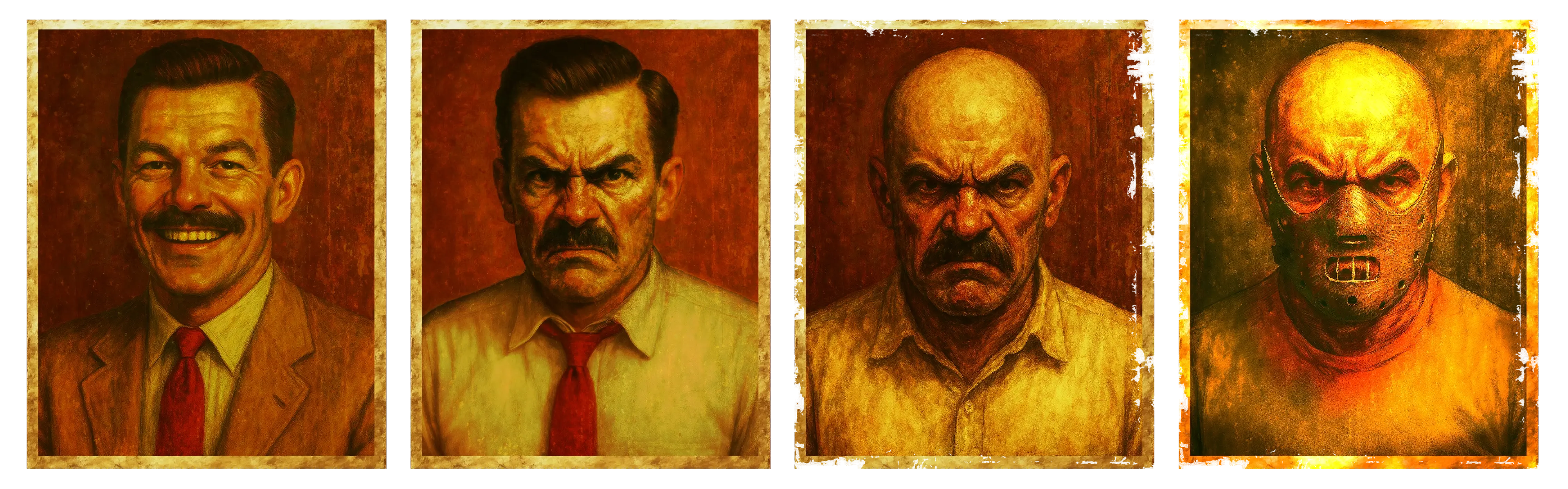
As the bonus level improves, the Smith family does not become happier.
They deteriorate.
The Better the Bonus, the Worse the Father
This is probably the single strongest visual idea in Disorder.
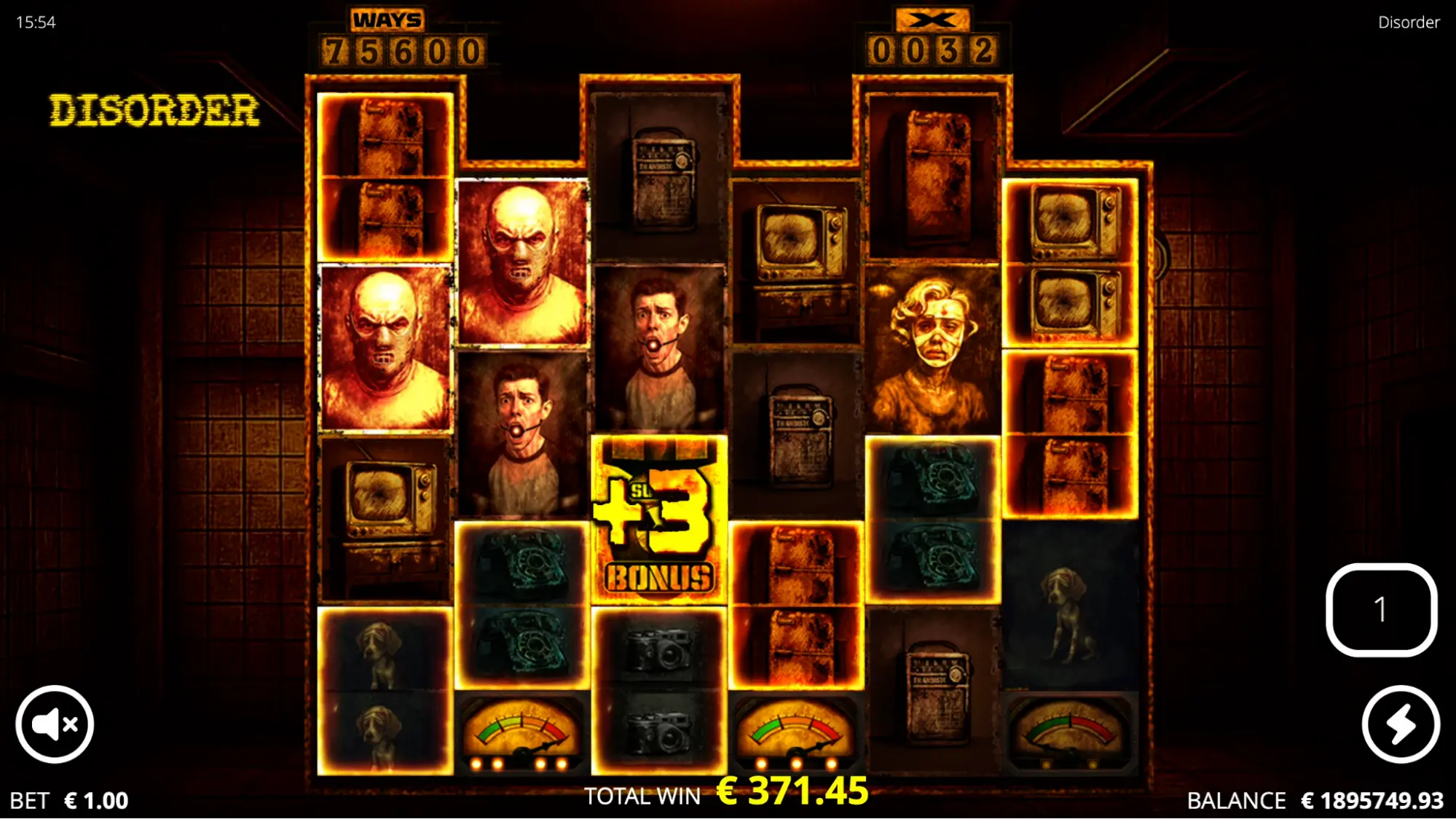
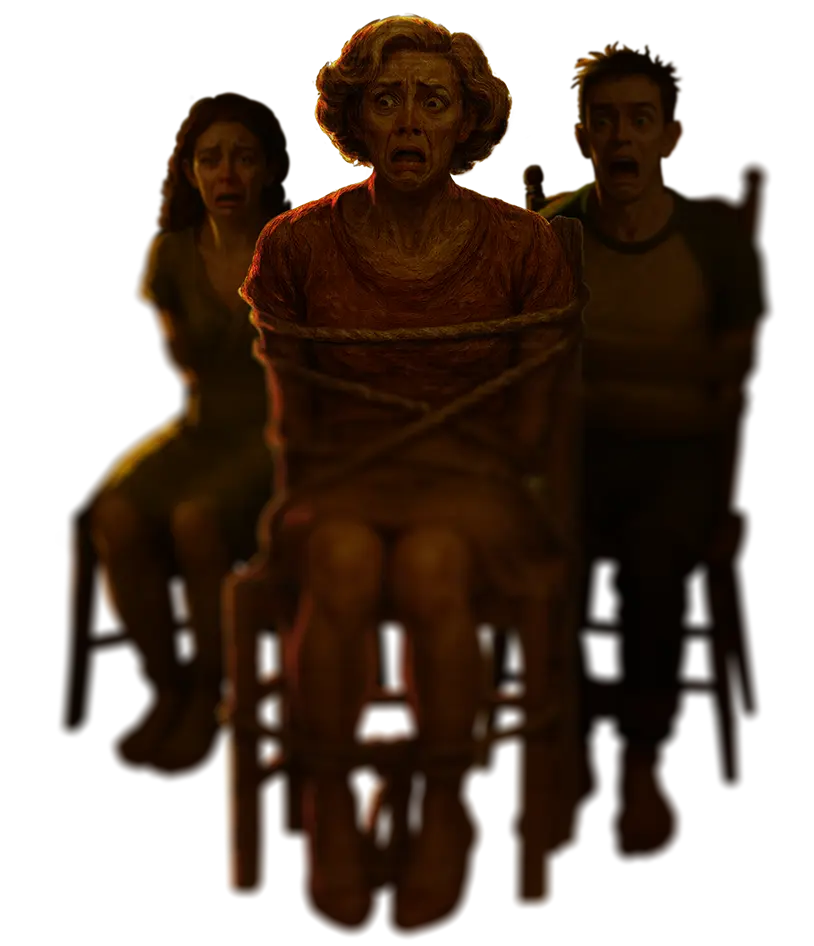
The family members have different states corresponding to the increasingly powerful Bonus Modes. Their clean suburban appearances begin degrading. Faces become more distressed. Clothes and bodies deteriorate. Domestic objects undergo the same transformation.
Even the house seems to descend with them:
suburban home → bunker → industrial nightmare → laboratory.
That makes the game's reward progression morally inverted.
Normally the better bonus means the game becomes more spectacular.
Here it also means John becomes worse.
The player wants the strongest version mechanically while watching the family move closer to catastrophe visually.
That relationship reminds me of Kenneth Must Die, but with an important difference.
Kenneth's transformations expose different sides of a double life. His respectable suburban identity and his underground sexual identity coexist because he wants both.
John's transformation is much more brutal.
This does not feel like revelation.
It feels like collapse.
The Diagnosis Gets Worse - But the Medicine Doesn't Work Like This
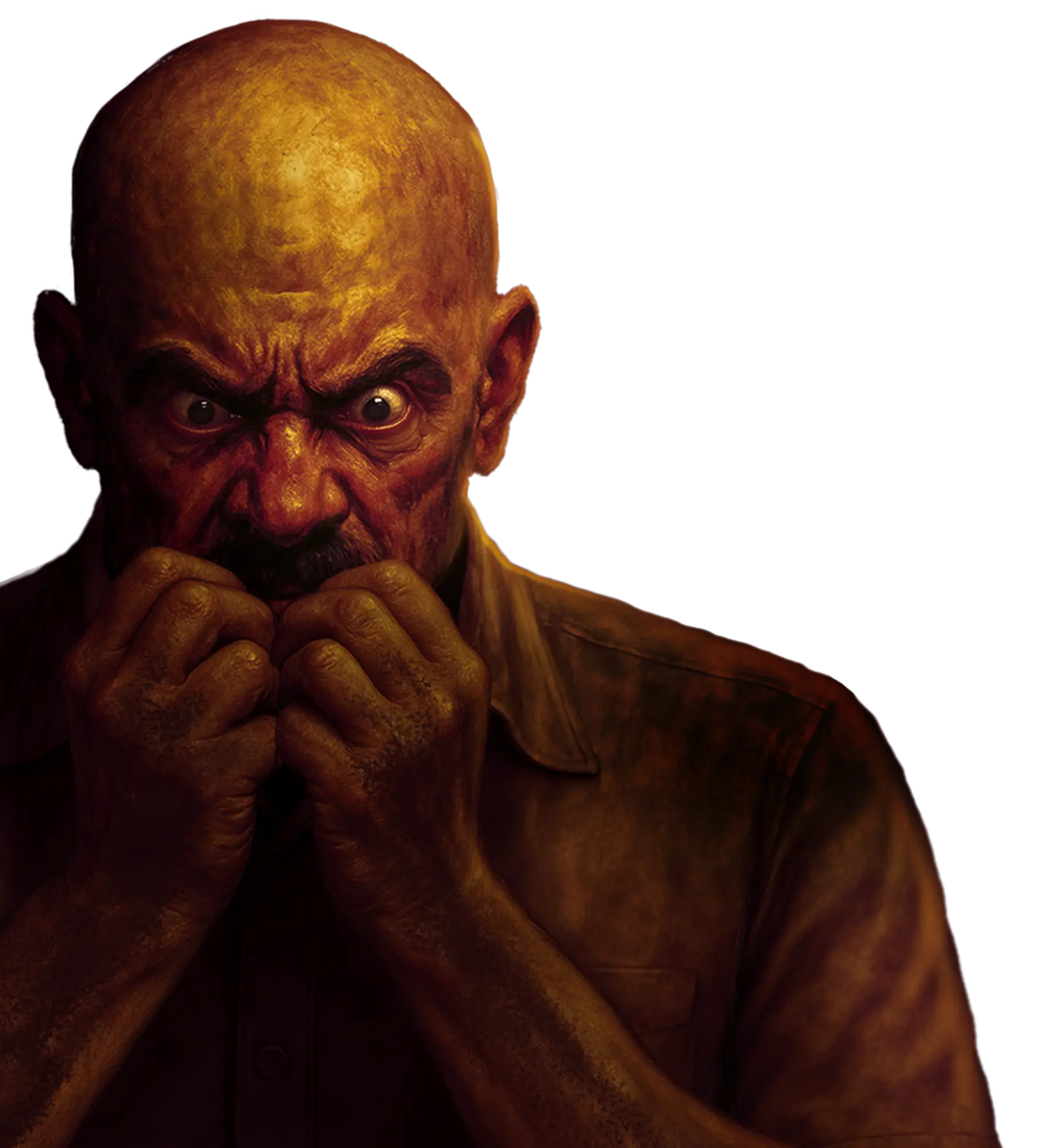
Nolimit City makes the progression explicit:
Obsessive Compulsive Spins
↓
Antisocial Personality Spins
↓
Severe Dissociative Identity Spins
The official release material goes even further, calling OCD John's “first sign,” his antisocial isolation the second, and dissociative detachment the final stage of his transition.
As horror language, it is effective.
As psychiatry, it should not be taken literally.
These are distinct conditions, not stages of one disease progressing from OCD into antisocial personality disorder and then into dissociative identity disorder.
The National Institute of Mental Health defines OCD around recurring unwanted obsessions and repetitive compulsions that can cause serious distress and interfere with everyday life. It is not shorthand for violent insanity.
Antisocial personality disorder is a separate personality disorder characterized by a persistent disregard for others' rights and consequences, while dissociative identity disorder concerns disruption of identity, memory and sense of self, commonly associated with severe trauma.
Nolimit City is therefore not constructing a medical progression.
It is constructing a horror progression out of psychiatric terminology.
That distinction matters.
And it is also fair material for criticism.
Mental Illness Becomes Horror Vocabulary
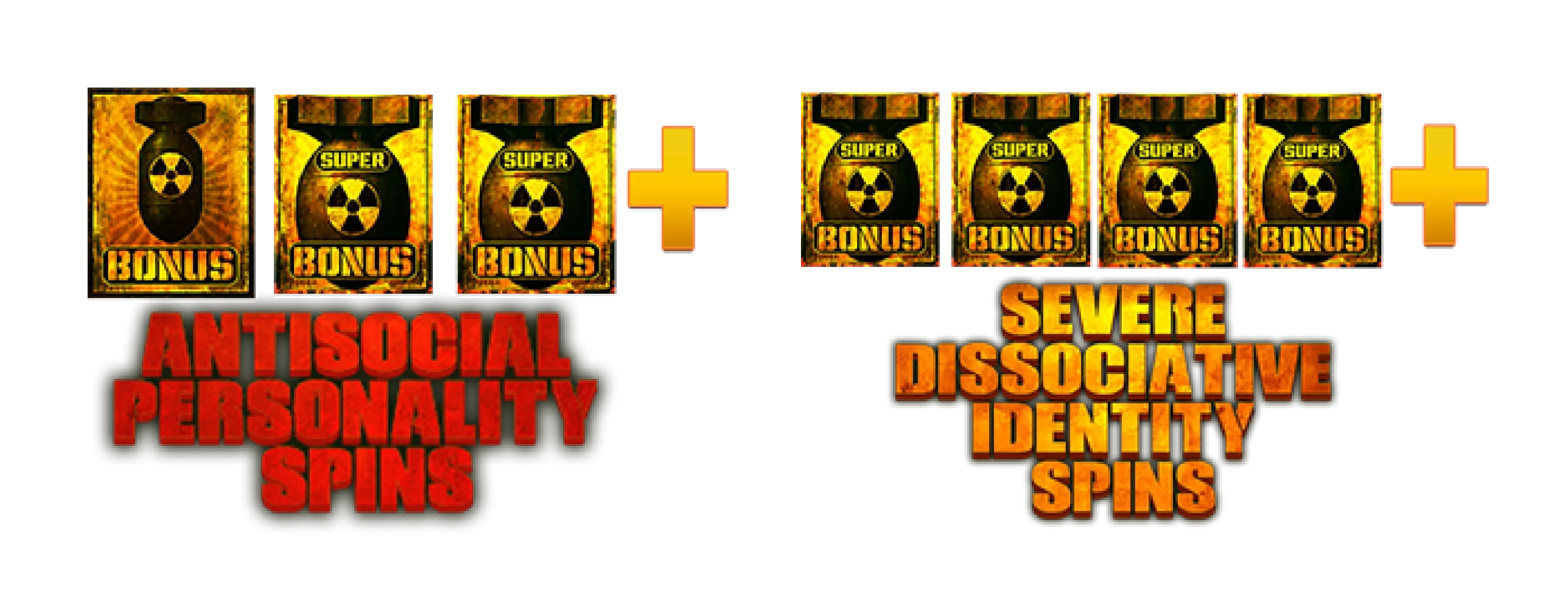
Nolimit City's Mental universe deliberately uses psychiatric institutions, diagnoses, restraint imagery and “insanity” as aesthetic material.
That tradition did not begin with Disorder. The original Mental is set inside an asylum filled with patients, doctors, autopsy imagery and increasingly grotesque mechanics.
But Disorder changes the perspective.
Instead of meeting the monster after institutionalization, we see the origin story.
Nolimit City itself calls Disorder the twisted origin story of Mental and Mental II.
That turns the game into something closer to a prequel tragedy.
We know where John is going.
We are watching how he gets there.
Before Mental There Was John
This also gives the later Mental imagery more weight.
The restrained, institutionalized figure from the series strongly recalls the cinematic language surrounding Hannibal Lecter, particularly the famous muzzle-like restraint associated with Anthony Hopkins in The Silence of the Lambs.
BFI describes Lecter's restraint as a human muzzle used to stop him biting his captors, and the image became one of the defining visual symbols associated with the character.
There is no reason to claim that Nolimit City officially based John on Hannibal Lecter unless the studio confirms it.
But the visual echo is difficult to miss.
Nuclear War Happens Before the Bomb Falls
The nuclear aspect of Disorder works even if no bomb actually destroys the Smith house.
That is because nuclear warfare has always had a psychological dimension.
Psychiatrist Robert Jay Lifton, who studied Hiroshima survivors and later wrote extensively about nuclear weapons, examined the psychological effects of living in a world where governments accumulate weapons capable of mass annihilation. His concept of psychic numbing describes, in part, the difficulty of emotionally processing destruction on a scale too enormous to fully imagine. Wiley Online Library
That gives Disorder a useful distinction:
The bomb does not need to explode physically.
It has already exploded psychologically.
John reorganizes his family around an anticipated catastrophe.
Fear changes the architecture of the home.
The possibility of annihilation becomes part of ordinary domestic life.
Nuclear war happens inside the imagination before it happens to the city.
Dr. Strangelove in the Basement
Stanley Kubrick found the same contradiction funny enough to build Dr. Strangelove around it.
The film turns the supposedly rational machinery of nuclear deterrence into black comedy: political and military systems designed to preserve security end up producing the possibility of total destruction. BFI describes the film as a Cold War comedy in which insanity and political maneuvering lead toward nuclear catastrophe, with Kubrick specifically recognizing the absurdity of mutually assured destruction.
Disorder is not satirical in the same way.
But the structural irony is similar.
The system created for protection becomes the source of danger.
At the national level, deterrence promises safety through catastrophic violence.
At the family level, John promises safety through total control.
Both rely on a paradox:
I must become capable of destroying you in order to keep you safe.
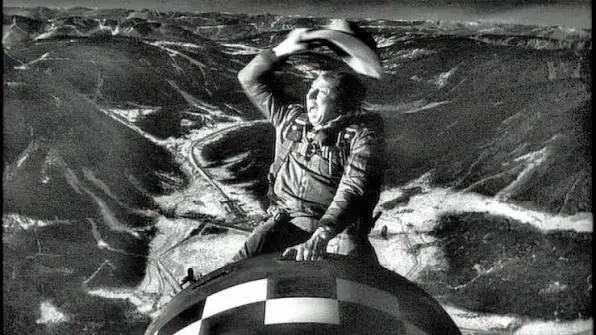
The bomb-riding finale of Dr. Strangelove (1964).
Where Disorder Becomes Mechanic
Fortunately, none of this disappears once the reels begin spinning.
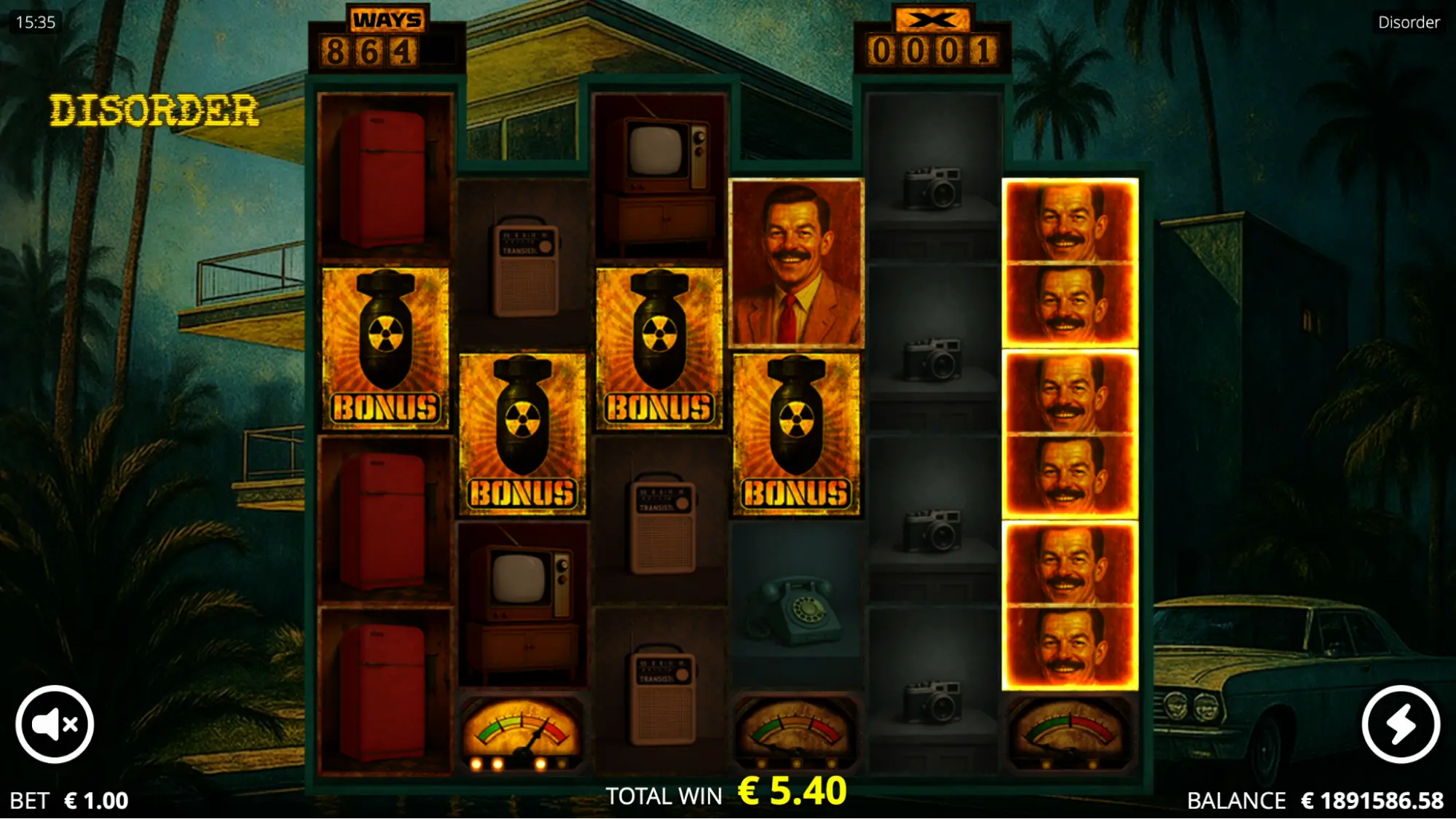
Disorder uses a 4-3-4-3-4-3 layout with Enhancer Cells at the bottom of reels 2, 4 and 6.
Fire Frames randomly appear on the reels. Anything landing inside one splits in two, with regular paying symbols capable of splitting repeatedly up to a maximum of 16. Bonus Symbols landing inside Fire Frames become Super Bonus Symbols. Already, the game is mechanically obsessed with instability.
One object becomes two.
The grid reproduces itself.
The more fire appears, the more systems activate.
And once enough Fire Frames accumulate, the hidden Enhancer Cells wake up.
The Enhancer Cells Are John's Head in Miniature
Four Fire Frames activate the first Enhancer Cell.
Seven activate two.
Nine activate all three.
After that, additional Fire Frames can reactivate them.The possible outcomes are practically a vocabulary of the entire game's psychology:
Molotov splits a selected symbol and its copies.
Delusion transforms symbols into the highest-paying symbol currently present.
Paranoia Multiplier adds anywhere from 1x to 999x to the win multiplier.
Nuclear Wild converts the regular symbols on its reel into Wilds.
xBomb® destroys non-winning regular symbols so new ones can fall.
And Family Symbol brings one of the five members of John's family onto the grid.
Look at those concepts together:
family + paranoia + delusion + political violence + nuclear destruction.
That is essentially the entire story compressed into six possible feature outcomes.
Destruction Is Productive
This is where Nolimit City does something very characteristic.
The worse the world becomes, the better the mathematics can become.
Fire causes splitting.
Bombs clear the grid.
Nuclear imagery creates Wilds.
Paranoia produces multipliers.
Delusion upgrades symbols.
And the escalating psychological states make the bonus increasingly powerful.
Breakdown is the reward system.
That is what makes Disorder more interesting than a game that simply places a mushroom cloud behind otherwise ordinary mechanics.
The game rewards the same process its narrative presents as catastrophic.
The player wants John to get worse.
Three Floors Down
The Bonus Mode depends on how many ordinary and Super Bonus bombs trigger it.
The weakest level, Obsessive Compulsive Spins, begins with six or more spins. Fire Frames and the multiplier reset after each spin.
Antisocial Personality Spins begin with eight or more spins and allow the multiplier to persist.
The strongest Severe Dissociative Identity Spins begin with the highest-level trigger, keep the multiplier running and make Fire Frames sticky. Mechanically, the descent therefore works exactly as the visual descent does:
more instability
→ more persistence
→ more accumulation
→ less resetting
→ more powerful chaos.
The game becomes progressively less capable of returning to normal.
Which is a very appropriate mechanic for a game called Disorder.
Murder, Then Reconstruction
The Big Win sequence makes the story considerably uglier.
Its progression moves through phrases such as:
Close the Door!
Let Me Out John!
Full Blown Psychosis
Murder
Rebuilding the Family
By the later stages, John is no longer merely hiding with his family.
He has destroyed it.
Then he attempts to reconstruct it.
The final laboratory imagery - bodies, containment tanks, John acting almost like a surgeon - adds another layer to the story.
Order has collapsed.
But John still wants order back.
He simply wants to rebuild it on his own terms.
That may be the darkest idea in the entire game.
The tyrant does not necessarily believe he loves chaos.
He may believe he is restoring order.
The Soundtrack Belongs to the House
The soundtrack follows the same basic contrast as the visuals.
The music begins from a nostalgic, period-coded domestic world and becomes increasingly uncomfortable as the game descends into John's bunker and laboratory.
The included track “I Got You” works particularly well because Disorder does not need generic horror drones from its first second.
The horror is more effective because it begins inside something that initially sounds and looks safe.
The soundtrack therefore participates in the same transformation as the family portraits and household objects:
normality first, corruption later.
The Theme Actually Survives Contact With the Gameplay
This remains one of the most important tests in La Part Maudite.
And Disorder passes it.
The family deteriorates as the bonus improves.
Fire Frames turn instability into multiplication.
Paranoia becomes a multiplier.
Delusion transforms reality.
Nuclear destruction becomes Wilds.
Bombs remove unwanted parts of the board.
The supposedly protective bunker becomes the site of family destruction.
And the better the mathematical state becomes, the worse John's psychological and moral state becomes.
None of this feels like a generic Nolimit City engine with a Cold War skin pasted onto it.
The mechanics participate in the collapse.
The Appeal
Exceptional narrative integration: the family story, environments, character transformations and bonus progression all develop together.
The Cold War-inspired suburban aesthetic gives the horror a strong contrast between domestic prosperity and nuclear anxiety.
John is more interesting than a generic horror villain because he begins as father, provider and protector.
Fire Frames, Enhancer Cells, Nuclear Wild, Delusion, Paranoia Multiplier and Family Symbols all reinforce the game's central ideas.
The stronger the Bonus Mode becomes, the more visually and narratively disturbing the family becomes.
Excellent connection to the established Mental universe without requiring players to know the previous games.
Strong Big Win progression culminating in murder and grotesque attempts to “rebuild” the family.
23,500x maximum win and characteristically aggressive Nolimit City feature interaction.
One of the better examples of a slot where political atmosphere, psychological horror and mathematics actually communicate with each other.
The Damage
Nolimit City's use of real psychiatric diagnoses as an escalating horror ladder is medically inaccurate and potentially stigmatizing.
The association between mental illness and extreme violence is deliberately sensationalized.
The number of interacting systems can become overwhelming for players who prefer cleaner mechanics.
Some of the Cold War/state-of-emergency reading comes from interpretation rather than explicit developer commentary, so the game itself does not fully articulate all of its most interesting political possibilities.
The bonus can occasionally feel a little “scripted”, but that is also classic Nolimit City. Some players may see the staged escalation as part of the excitement rather than a drawback
Some character and promo art can look AI-generated, though that may be misleading, and Nolimit City has rejected such claims.
Extra Spin purchases can feel intrusive, interrupting the bonus flow with another spending prompt.
La Part Maudite Final Spin - 7.5/10
Disorder begins with something extraordinarily ordinary.
The basic promise of postwar American stability.
Then an emergency enters the picture.
The family moves toward protection.
Protection becomes confinement.
Confinement becomes authority.
Authority becomes violence.
And eventually the man responsible for preserving the family destroys it and attempts to reconstruct what remains.
That is why the nuclear imagery matters.
The bomb is not only a weapon sitting outside the house.
It is the force that reorganizes the relationships inside it.
Compared with Kenneth Must Die, the suburban house again hides another world beneath it.
But Kenneth goes downstairs because he desires what is there.
John takes his family downstairs because he believes they need to be saved.
That difference changes everything.
The darkest idea in Disorder is not that order eventually collapses into chaos.
It is that chaos can arrive while still calling itself order.
La Part Maudite score: 7.5/10.

The series title is inspired by Georges Bataille's 1949 work La Part maudite.
Related reading
NUUKD Slot Review: The Last Mother Wants More
Welcome to the post-human world of NUUKD - where humanity is gone, AI has won, and Mother sends her Babydrills beneath Greenland’s ice in search of “green gold.” We explore the Venus of Willendorf-inspired Mother, radioactive extraction, EVE, Lady Liberty, Mother Frackr, Drill Baby Drill, and how Shady Lady turns resource hunger into the game’s story, visuals and mechanics.
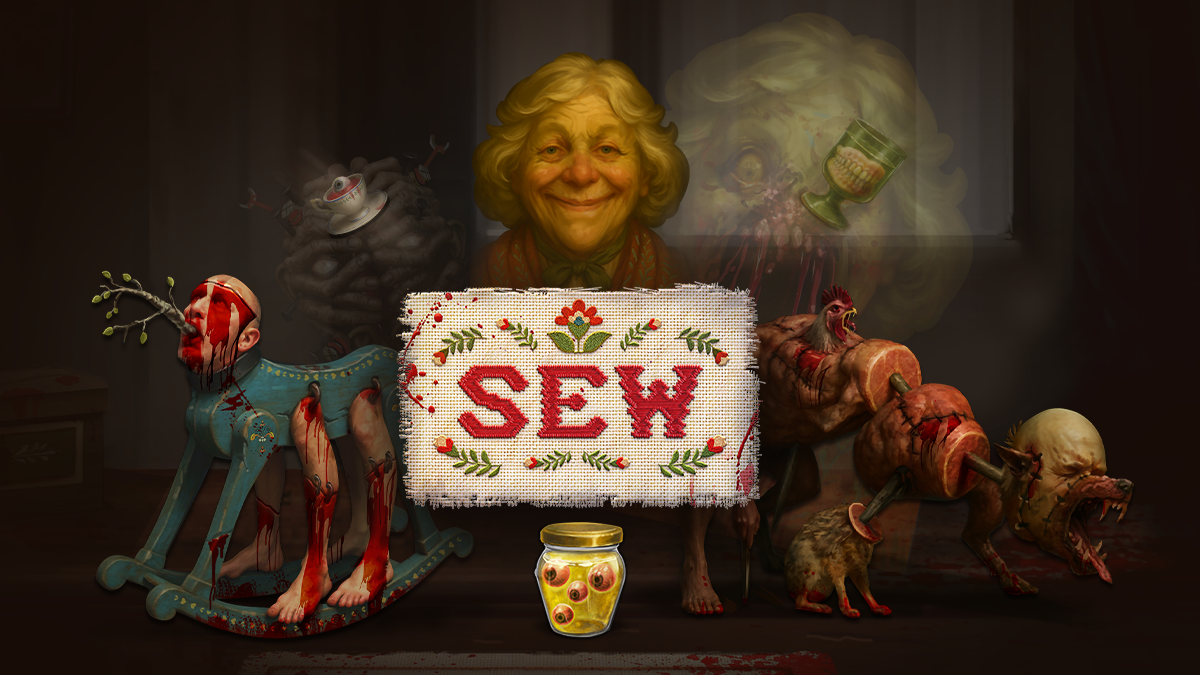
SEW Slot Review: Human Body as a Material
In SEW, knitting, folklore and domestic imagery are transformed into something far more disturbing — a full-scale exercise in body horror. We examine the old woman behind the Scatter, the grotesque transformation of the body, the game’s Norse and fairy-tale references, and the way Shady Lady turns stitching, skin, flesh and mythology into mechanics that feel inseparable from the theme — resulting in one of the most complete and unsettling games in the series.